








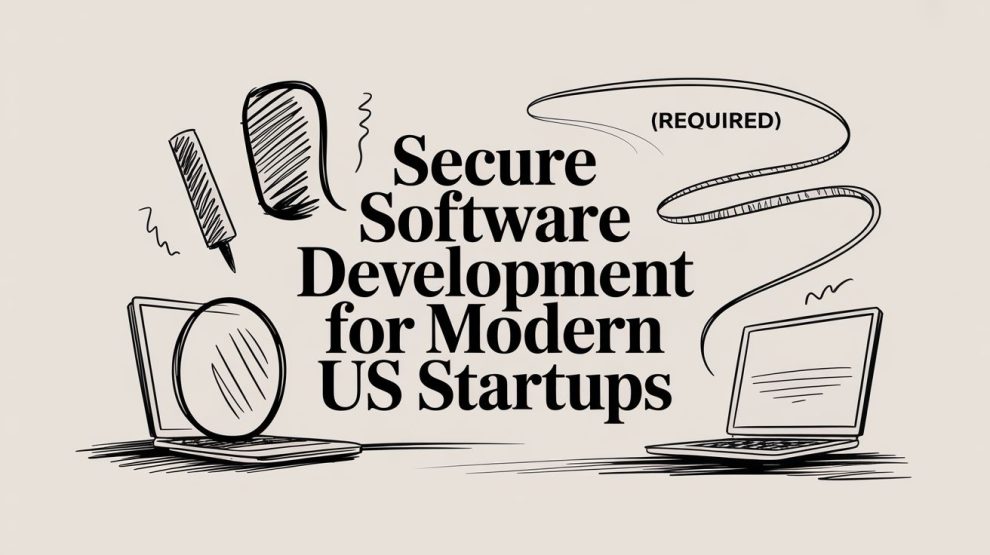

Secure software development simply means weaving security into every single step of building your product, from the first whiteboard sketch to the moment you ship. Instead of treating security like a last-minute inspection you have to pass, it becomes a core part of the process. The goal is to build applications that are resilient and trustworthy from the very beginning.
Why Security Is Your Startup's New Growth Engine
If you're running a startup in the US, speed is the name of the game. The pressure to push features and grab market share is immense, and security often feels like a roadblock—something expensive and time-consuming you’ll get to "later."
But here's the trap: ignoring security doesn't actually save you time. It just racks up a hidden liability called security debt.
Think of it exactly like financial debt. When you ship code with vulnerabilities, you're essentially taking out a high-interest loan. You get a quick boost in speed, but that debt sits in the background, quietly growing. As you layer on more features, the "interest"—the risk and cost of fixing those early mistakes—compounds. Eventually, one small incident can trigger a complete meltdown.
The Rising Cost of Security Debt
This isn't just some abstract concept. The push to innovate faster, especially with AI tools churning out code, has turned security debt into a full-blown crisis. Take a look at the challenges tech leaders are facing.
A quick overview of the key challenges faced by modern software development teams, highlighting why security has become the number one concern.
Top Software Development Challenges for Tech Leaders in 2026
| Challenge | Percentage of Leaders Citing It as Top Concern | Relevance to Startups |
|---|---|---|
| Managing Security Debt | 82% | Unpatched vulnerabilities create a fragile product, risking data breaches and reputational ruin. |
| Adopting AI Securely | 75% | AI-generated code can introduce new, subtle security flaws that are hard to catch manually. |
| Developer Skill Gaps | 68% | Finding engineers who are both skilled developers and security-conscious is a major hiring hurdle. |
| Keeping Pace with Threats | 61% | Attack methods evolve constantly, making reactive security measures obsolete almost overnight. |
Recent data is alarming. In 2026, a staggering 82% of organizations are wrestling with security debt, which is an 11% increase from the previous year. Even more concerning, 60% of those companies are dealing with 'critical' debt, where the vulnerabilities are severe enough to cause catastrophic damage. You can dig into the complete analysis in Veracode's latest software security report.
When you let unresolved flaws pile up, you're building your entire business on a shaky foundation. It stops being a question of if a breach will happen, and starts being a question of when.
Security isn't a cost center; it's a competitive advantage. Proactive secure software development protects your brand, accelerates compliance, and unlocks access to enterprise clients who won't do business with a vulnerable partner.
Security as a Business Enabler
It's time to flip the script. Secure software development isn't about slowing down; it's about building a business that lasts. When done right, a strong security posture stops being a drag and becomes a powerful engine for growth.
Think about the immediate business wins:
- Brand Protection: For a startup, reputation is everything. A single, high-profile breach can evaporate customer trust overnight—a blow most young companies can't recover from. Building securely from day one establishes you as a serious, reliable player.
- Compliance Readiness: Many industries require you to meet standards like SOC 2 or HIPAA. When security is already part of your DNA, achieving and maintaining compliance becomes far simpler and cheaper.
- Winning Enterprise Deals: Big corporate clients have zero tolerance for security risks. Having a mature, secure development process is often a non-negotiable requirement to even get in the door. It’s what separates you from the competition and lands those game-changing contracts.
At the end of the day, secure development isn't just a technical task for your engineers. It’s a core business strategy that lets you build a company that can earn trust, weather attacks, and scale with confidence.
Understanding the Secure Software Development Lifecycle
For too long, security has been the thing you staple on at the end—a frantic, last-minute check right before shipping. That’s like building an entire house and only then remembering to add locks and smoke detectors. It’s chaotic, expensive, and leaves you dangerously exposed.
The right way to do it is with a Secure Software Development Lifecycle (SSDLC). This isn't some rigid, bureaucratic checklist. Think of it as a mindset, a framework for weaving security into the very DNA of your product from day one. It works hand-in-hand with modern DevOps, making security everyone's job, not just a final gatekeeper's problem.
By tackling potential vulnerabilities from the start, you build a product that's resilient and trustworthy right out of the box.
This simple hierarchy shows how a real commitment to secure development pays off. It's a direct line from good practice to business success, where compliance builds the trust that ultimately fuels growth.

As you can see, security stops being a cost center and becomes a strategic investment. Let's break down what that actually looks like stage by stage.
Phase 1: The Requirements Phase
This is the blueprint stage, where you’re deciding what your software needs to do. In a secure lifecycle, this is also where you define your security and compliance requirements.
Instead of just dreaming up features, you need to ask some tough questions early on:
- What kind of sensitive data are we dealing with? Think PII, financial records, or health information.
- What regulations do we absolutely have to follow? This could be SOC 2, HIPAA, or something else entirely.
- What's the bare minimum level of security our customers will demand from us?
Nailing these answers down upfront saves you from expensive and painful redesigns down the road. It’s the difference between an architect putting fire suppression in the original blueprints versus trying to retrofit sprinklers after the drywall is up.
Phase 2: The Design Phase
With your "what" figured out, the design phase is all about the "how." This is the perfect time for threat modeling—a structured brainstorming session where your team puts on their black hats to think like an attacker.
Threat modeling is about finding security holes before you’ve written a single line of code. It’s the cheapest, easiest point to identify and fix major risks.
You’ll also establish secure design patterns here. A classic one is the principle of "least privilege," which means any part of your system should only have the absolute minimum permissions it needs to function. It’s the digital version of giving an employee a keycard that only unlocks the specific rooms they need to enter, and nothing more.
Phase 3: The Development and Testing Phases
Now we get to the coding and bug-squashing. In an SSDLC, security testing isn’t a one-off event at the end. It's woven directly into the development sprints.
This continuous loop includes:
- Secure Coding Training: Giving your developers the skills to spot and avoid common pitfalls like injection attacks or weak authentication.
- Automated Scanning: Using Static Application Security Testing (SAST) tools that scan your raw code for vulnerabilities as it’s being committed.
- Dynamic Analysis: Running Dynamic Application Security Testing (DAST) tools against your live, running application to find flaws that only show up during runtime.
This constant feedback catches security issues early and prevents "security debt" from piling up—the kind of debt that can easily sink a startup.
Phase 4: The Deployment and Maintenance Phases
Your software is live! But the job isn't done. Security is a continuous effort that extends long after deployment. This phase is all about keeping your application safe in the real world.
Key activities here involve continuous monitoring for any weird behavior, having a solid incident response plan ready to go, and diligently patching your app and all its third-party dependencies. Committing to a secure lifecycle means you’re protecting your product for the long haul, building unshakable customer trust and ensuring your business is resilient for whatever comes next.
Implementing Core Secure Development Practices
Okay, enough with the high-level theory. Let's get our hands dirty and talk about what putting a secure development lifecycle into practice actually looks like. These aren't just complex rituals for massive enterprises; they are real, tangible techniques your startup can start using right away. Each one is designed to tackle a specific kind of risk, and when you put them together, they form a formidable defense for your product.
This isn't just a "nice-to-have" anymore. When tech leaders were recently asked about their biggest hurdles for 2026, security was the clear winner, with 51% citing it as their top challenge. That number now eclipses concerns like AI code reliability (45%) and even data privacy (41%). The message is clear: in a world of rapid development, security vulnerabilities have become a boardroom-level problem. You can read the full report on top software development challenges to see just how much the priorities have shifted.
So, let's break down the essential practices that form the backbone of modern secure software development.
Start with Threat Modeling
Before you even think about writing a line of code, you have to learn to think like an attacker. Threat modeling is just a structured way of doing that. It’s a process for brainstorming potential security threats, identifying weak spots in your design, and figuring out how to stop them before they become real problems.
Honestly, this is the cheapest and fastest way to find and fix major architectural flaws.
Imagine you're building a new login feature. Threat modeling forces you to ask the hard questions upfront:
- Could someone pretend to be a legitimate user and bypass our login? (Spoofing)
- Is it possible for an attacker to intercept a user’s password as it travels over the network? (Tampering)
- What if a bug accidentally exposes sensitive user profile data? (Information Disclosure)
- Can a bad actor launch an attack that locks everyone out of their accounts? (Denial of Service)
Answering these questions during the whiteboard phase lets you design defenses from the ground up, instead of scrambling to patch critical holes after launch.
Build on Secure Design Principles
Once you've got a map of your potential threats, you can design your software to be naturally tough. Secure design principles aren't complicated; they're foundational rules of thumb that shrink your attack surface and limit the damage if a breach does happen.
The single most important principle for any startup is least privilege. It means that any part of your system—a user account, a microservice, a third-party integration—should only have the bare minimum permissions it needs to do its job. Nothing more.
Think of it like a modern hotel keycard. A guest's card opens their room and maybe the pool, but it won't open the penthouse or the server room. Applying this logic to your software—like ensuring a reporting service has read-only access to the database—dramatically contains the blast radius if that service is ever compromised.
Automate Your Code Analysis with SAST and DAST
You can't have your team manually inspect every line of code for security flaws, not if you want to move at startup speed. This is where automated security testing tools become your best friends. The two main types you'll hear about are SAST and DAST.
Static Application Security Testing (SAST): Think of a SAST tool as an incredibly powerful spell-checker for security bugs. It scans your raw source code and config files to find common vulnerabilities like SQL injection or weak encryption before the code is even run.
Dynamic Application Security Testing (DAST): If SAST is the spell-checker, DAST is the live-fire drill. It attacks your running application from the outside, just like a real hacker would, to find runtime issues that are impossible to see in the source code alone.
By running SAST tools every time a developer commits code and DAST tools in your testing environment, you create a constant feedback loop. This lets your team find and fix security bugs as a normal part of their workflow. For a deeper look, check out our comparison of DAST vs. penetration testing.
Manage Your Open-Source Dependencies
Let's be real: modern software is assembled, not just written. Your team is pulling in hundreds of open-source libraries to build faster. But here's the catch: you also inherit all of their security risks. A staggering 77% of applications have at least one known vulnerability because of an open-source component they use.
This is where Software Composition Analysis (SCA) tools are absolutely essential. An SCA tool plugs into your project and automatically does three critical things:
- Builds a complete inventory of all your open-source parts.
- Checks that list against public databases of known vulnerabilities.
- Alerts you instantly when a dependency is outdated or has a security flaw.
In today's environment, this practice is completely non-negotiable.
Protect Your Keys with Secrets Management
Finally, you have to lock down your "secrets"—all those API keys, database passwords, and private certificates. Hardcoding a secret directly into your source code is the digital equivalent of taping your house key to the front door. If your code repository ever gets leaked, your entire infrastructure is wide open.
Secrets management is the practice of using a dedicated, secure tool (like a digital vault) to store and manage access to these credentials. These systems give you a central place to control access, audit who used what and when, and even automatically rotate keys. This ensures your most critical credentials are never accidentally exposed.
Integrating Security into Your DevOps Pipeline

All the theory behind secure software development is one thing, but where it really comes to life is in your team's day-to-day workflow. This is the heart of DevSecOps: embedding security directly into the DevOps pipeline you already have. The idea isn't to add friction or slow developers down, but to make security a seamless, automated part of how you build and ship code.
Think of it as a series of automated "security gates" sprinkled throughout your pipeline. Instead of a single, massive security review right before launch, these gates act as checkpoints. Code has to pass a specific security test before it can move to the next stage. If it fails, the build stops, and the developer gets immediate feedback—letting them fix the problem while the code is still fresh in their mind.
Shifting Security Left in the CI/CD Pipeline
You’ll hear the term "shift left" a lot, and for good reason. It simply means moving security tasks as early as possible in the development lifecycle. In a CI/CD pipeline, this translates to building security checks directly into the Continuous Integration (CI) stage, long before code ever sees a production server. It’s the single most effective way to catch issues early, when they're cheapest and easiest to fix.
Here’s what that looks like in practice:
- On Code Commit: The moment a developer pushes code, a Static Application Security Testing (SAST) tool can automatically scan it. This is your first line of defense, catching common bugs like potential SQL injection flaws or accidentally hardcoded API keys.
- On Pull Request: Before any new code gets merged into the main branch, other checks can trigger. This is the perfect time for Software Composition Analysis (SCA) to scan for known vulnerabilities in the open-source libraries your project depends on.
This immediate feedback loop is a game-changer. It transforms developers from being the source of security problems to being the solution. You're not pointing fingers; you're giving them the tools to find and fix issues on the spot.
Securing Your Infrastructure and Containers
Today’s applications are more than just code; they’re also the infrastructure they run on. A perfectly secure application running on a poorly configured cloud environment is still a massive risk. This is why Infrastructure as Code (IaC) scanning and container security are critical gates in any modern pipeline.
By automating security checks within your DevOps workflow, you make security a scalable habit, not a bottleneck. This ensures that as your startup grows and deployment frequency increases, your security posture strengthens right along with it.
Tools like Terraform and AWS CloudFormation let you define your cloud infrastructure in code, which is fantastic for speed and consistency. But a typo or misconfiguration in a template—like a publicly exposed S3 bucket or an overly permissive firewall rule—can create a gaping security hole. An IaC scanner in your pipeline finds these problems before the infrastructure is ever provisioned.
Likewise, containers need hardening. A robust pipeline should scan every container image for known vulnerabilities before it’s pushed to a registry like Docker Hub. This simple step prevents a compromised base image from becoming the weak link in your entire application.
To put it all together, this table shows how different security tools map to the stages of a typical DevOps workflow. It's a practical blueprint for building out your own DevSecOps process. For a deeper look, our guide on integrating security in DevOps offers even more detailed strategies.
Mapping Security Tools to the DevOps Pipeline
| DevOps Stage | Security Action | Example Tool Type |
|---|---|---|
| Commit/Build (CI) | Scan code for vulnerabilities and check for vulnerable open-source dependencies. | SAST & SCA Tools |
| Test (CI) | Scan running application for runtime flaws and test infrastructure templates. | DAST & IaC Scanners |
| Deploy (CD) | Scan container images for known vulnerabilities before pushing to a registry. | Container Scanners |
| Runtime (Operate) | Continuously monitor for threats, anomalies, and active attacks in production. | Runtime Protection (RASP) |
By mapping these automated checks to your existing DevOps stages, you build a system where security is baked in, not bolted on. This approach ensures your secure software development practices scale with your team, allowing you to innovate quickly without accumulating dangerous security debt.
Building a Security-First Team and Culture

You can have the most advanced automated tools and a perfectly hardened CI/CD pipeline, but those defenses only go so far. At the end of the day, your single greatest asset in secure software development isn't a piece of software—it's your people.
This is where building a security-first culture comes in. It’s about shifting security from a gatekeeper’s checklist to a shared responsibility that’s just part of how everyone works. The goal isn’t to make everyone a security expert, but to empower them to think defensively.
This kind of change has to start from the top. When leadership actively invests in and talks about security, it signals that it's a fundamental part of the business, not just an IT problem.
Hiring for a Security Mindset
A strong security culture begins the moment you start hiring. While knowing a specific tool is helpful, what you’re really looking for is a certain mindset. In the long run, a candidate’s natural curiosity and cautious approach to building software will be far more valuable than their familiarity with any single platform.
When interviewing for technical roles, especially in DevOps, you need to dig deeper than the resume. You aren't just hiring an engineer; you're looking for someone who instinctively looks for weak spots.
A security-conscious culture doesn't happen by accident. It's built through intentional hiring, continuous training, and creating a system where security is a shared goal, not a source of blame.
Here are a few questions I’ve found useful for uncovering a candidate's security instincts:
- "Describe a time you found a security flaw in your own code or a teammate's. What was the flaw, and how did you handle it?"
- "Imagine you're reviewing a pull request that adds a new feature. What specific security concerns would you look for?"
- "How would you explain the principle of 'least privilege' to a junior developer and give a practical example of its implementation?"
- "If you discovered a critical vulnerability in a third-party library we depend on, what would be your immediate steps?"
Their answers will tell you a lot about how they solve problems and whether they see security as a core part of their job. If you want a more detailed breakdown of this role, check out our guide on what makes a top-tier DevSecOps Engineer.
Evaluating Third-Party Partners and Consultants
Most startups lean on outside help, whether it's freelancers, consultants, or managed service providers. When you bring a partner on, you’re not just outsourcing a task; you’re handing them the keys to your product's security. It's critical to vet them just as thoroughly as you would a full-time employee.
Don't just accept their marketing claims at face value. Ask for cold, hard data that proves their commitment to security.
A trustworthy partner should be able to back up their promises with clear metrics. Here’s a quick checklist of what to ask for:
- Vulnerability Remediation Metrics: What is their average Mean Time to Remediate (MTTR) for critical and high-severity vulnerabilities? A low number shows they act fast when it matters.
- Compliance Experience: Have they actually helped clients get through audits like SOC 2 or HIPAA? Ask for references or case studies.
- Security Training: How do they keep their own engineers sharp? A team that invests in ongoing training is one that can keep up with emerging threats.
By focusing on the people you hire and the partners you trust, you build a powerful human firewall. This sense of shared ownership is what turns a good security program into a great one.
Making the Business Case for Your Security Program
Let's be honest: talking security with executives or investors can feel like you're speaking a completely different language. You’re focused on vulnerabilities and CVEs, while they’re focused on the P&L statement. To get the green light for a secure software development program, you have to bridge that gap and talk about security in the one language everyone understands: business value.
This isn't about scaring them with technical jargon. It’s about reframing the conversation entirely. Stop letting security be seen as just another cost center. Instead, present it for what it truly is: a core business function that protects your company from disaster and, more importantly, unlocks new revenue.
What Does This Actually Cost?
Before you can talk about returns, you have to be upfront about the investment. The good news is that for a US-based startup, the costs are predictable and can be scaled as you grow. Your budget will generally fall into three buckets.
Here’s a realistic look at where your initial investment will go:
- Essential Tooling: This means subscriptions for your core scanners—SAST, DAST, and SCA. You don't need the most expensive enterprise suite right away; many vendors have startup-friendly pricing tiers that get the job done.
- Team Training: Your developers are your first line of defense. Budgeting for secure coding workshops or courses is one of the highest-impact investments you can make. It builds skills that pay dividends long after the training ends.
- People Power (Hires or Consultants): As you grow, you’ll likely need dedicated expertise. This could mean hiring your first security engineer or bringing in a consultant for specific tasks like a formal penetration test or to help design your security roadmap.
These aren't just line items on a spreadsheet; they are direct investments in your company's stability and future.
A strong security posture isn't just a defensive shield—it's a powerful sales tool. In today's market, proving your commitment to security can be the deciding factor that helps you win and retain high-value enterprise customers.
How to Frame the Return on Investment (ROI)
This is where you connect the dots for the leadership team. The ROI on security isn't about direct profit—it’s about preventing catastrophic costs and enabling sales. A solid security program delivers real, measurable financial benefits, and that’s the story you need to tell.
The most obvious win is avoiding a data breach, where the average cost can easily run into the millions. For a startup, that’s a company-ending event. Every single vulnerability you find and fix early is money you’ve saved from a potential disaster.
When you're making your case to the board, focus on these three things:
- Lowering the Risk of a Breach: Proactive security isn't a guarantee, but it drastically reduces the odds of an incident that brings financial penalties, lawsuits, and a brand reputation that's nearly impossible to repair.
- Cutting Down Compliance Costs: Building security in from day one makes achieving certifications like SOC 2 or HIPAA exponentially cheaper and faster down the road. This directly unblocks deals with bigger, compliance-driven customers.
- Creating a Sales Advantage: Enterprise clients will ask about your security. When they do, being able to point to a mature, well-documented secure development process becomes a massive competitive differentiator that gets contracts signed.
By framing it this way, you move the conversation from technical debt to business strategy. You show them that investing in security isn't just a responsible move—it's one of the smartest financial decisions a growing company can make.
Your Questions About Secure Development, Answered
Let's tackle some of the most common questions and hesitations we hear from startups. These are the practical hurdles that come up when you're trying to build securely while also moving fast.
Is Secure Development Only for Big Companies?
Not at all. While big corporations have the budget for massive security teams, the principles of secure development are arguably more important for a startup. For a young company, a single serious data breach isn't just a PR problem—it can be an extinction-level event.
Think of it this way: proactive security is a survival tactic, not a luxury item. Thanks to modern automation and developer-friendly tools, it's completely achievable for small teams. The goal isn't to be impenetrable, but to build a resilient product that protects your brand and earns the trust you need to grow.
Won't This Slow Down Our Development Speed?
This is the classic fear, but it’s based on a misunderstanding of where the real slowdowns happen. Ignoring security doesn’t make you faster; it just racks up security debt. This debt comes in the form of hidden flaws that are exponentially more expensive and time-consuming to fix down the road.
A quick chat to fix a flaw during the design phase takes minutes.
Finding that same flaw after a customer's data has been compromised? That means pulling everyone off their work for emergency patches, drafting apology emails, and dealing with the reputational fallout for weeks.
When done right, security becomes an accelerator. Automated tools give developers instant feedback, catching issues before they ever become a problem. It builds confidence and, in the long run, makes your team faster and your product stronger.
What Is the Single Most Important Practice to Start With?
If you only have the bandwidth to do one thing, start with Software Composition Analysis (SCA). Nearly every modern application is built on a mountain of open-source code, and when you use a library, you inherit all of its vulnerabilities.
An SCA tool automatically scans every dependency you use and flags known security holes. It’s the lowest-hanging fruit you can pick, offering a huge reduction in your attack surface right out of the gate. It's the best bang for your buck, period.
Once you have that in place, make secrets management your next priority. Protecting your API keys and credentials is just as critical.
At DevOps Connect Hub, we focus on giving US startups the practical guides and vendor insights needed to build secure, scalable systems. Find out how to plan, hire, and grow your DevOps efforts at https://devopsconnecthub.com.





Add Comment