





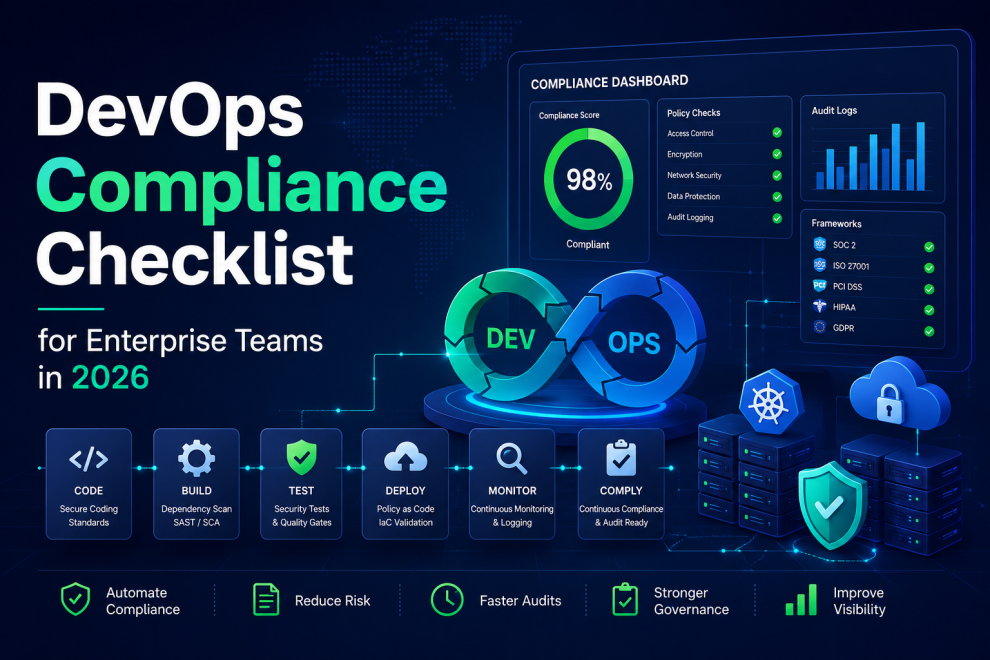

Speed has become the defining metric for modern software delivery, but for enterprise organizations, speed alone is no longer enough. Every deployment must also meet increasingly stringent compliance, security, and governance requirements.
Whether your organization operates in finance, healthcare, insurance, retail, or SaaS, regulatory frameworks such as SOC 2, ISO 27001, PCI DSS, HIPAA, and GDPR have become integral to software delivery. The challenge is maintaining developer velocity without introducing compliance risks that delay releases or expose the business to costly penalties.
This is where modern DevOps practices have evolved. Instead of treating compliance as a final approval step, leading engineering organizations are embedding it directly into their CI/CD pipelines, infrastructure, and deployment processes. Often referred to as continuous compliance or compliance as code, this approach enables teams to build secure, auditable systems without sacrificing agility.
Why Traditional Compliance No Longer Works
For years, compliance was handled through manual audits, documentation, and periodic reviews. While this approach satisfied regulatory requirements, it often slowed software delivery and created bottlenecks between engineering, security, and compliance teams.
Today’s cloud-native environments are fundamentally different. Infrastructure changes daily, containers are ephemeral, deployments happen multiple times a day, and AI-powered applications introduce new governance challenges. Manual reviews simply cannot keep pace.
Enterprise organizations are replacing periodic compliance checks with automated controls that continuously validate infrastructure, code, and deployments throughout the software lifecycle.
1. Shift Compliance Left
The earlier compliance issues are detected, the less expensive they are to fix.
Rather than waiting until production, compliance validation should begin during development. Developers should receive immediate feedback when code introduces security vulnerabilities, violates organizational policies, or fails regulatory requirements.
Integrating compliance into pull requests, code reviews, and automated testing reduces remediation effort while encouraging developers to build secure applications from the beginning.
2. Treat Infrastructure as Code
Infrastructure has become one of the most critical components of compliance.
Whether your organization uses Terraform, Pulumi, AWS CloudFormation, or Azure Bicep, every infrastructure change should be version-controlled, peer-reviewed, and automatically validated before deployment.
Infrastructure as Code provides complete visibility into cloud resources while creating an audit trail that simplifies regulatory reporting.
It also minimizes configuration drift, one of the most common causes of compliance failures in enterprise environments.
3. Implement Policy as Code
Policies should never exist only in documentation.
Modern enterprises are increasingly adopting Policy as Code to automate governance across cloud infrastructure and Kubernetes environments.
Instead of relying on manual reviews, policy engines can automatically verify whether deployments comply with organizational requirements before reaching production.
Examples include:
- Blocking public storage buckets
- Enforcing encryption standards
- Validating Kubernetes security policies
- Restricting privileged containers
Automated policy enforcement improves consistency while significantly reducing operational risk.
4. Secure the CI/CD Pipeline
The CI/CD pipeline has become a high-value target for attackers because it controls how software reaches production.
Every pipeline should include automated security controls such as dependency scanning, secret detection, static application security testing (SAST), software composition analysis, and artifact verification.
Access to deployment pipelines should follow the principle of least privilege, with strong authentication and comprehensive audit logging.
Securing the delivery pipeline protects not only applications but also the integrity of the entire software supply chain.
5. Continuously Monitor Cloud Environments
Compliance does not end after deployment.
Cloud infrastructure changes constantly as new resources are created, updated, or removed. Continuous monitoring ensures that environments remain aligned with security and regulatory requirements.
Organizations should monitor for unauthorized configuration changes, excessive permissions, unencrypted storage, exposed APIs, and network policy violations.
Real-time visibility allows engineering teams to identify compliance drift before it becomes a business risk.
6. Strengthen Identity and Access Management
Identity has become the new security perimeter.
Every user, service account, API, and automation tool should have only the permissions required to perform its responsibilities.
Enterprises should regularly review privileged accounts, rotate credentials, implement multi-factor authentication, and eliminate long-lived secrets wherever possible.
Modern identity management significantly reduces the attack surface while supporting regulatory requirements around access control and accountability.
7. Maintain Complete Audit Trails
Auditors increasingly expect organizations to demonstrate not only that controls exist but also that they are consistently enforced.
Every infrastructure modification, deployment, configuration change, and production release should generate immutable audit records.
Centralized logging platforms help security and compliance teams investigate incidents while simplifying external audits.
Comprehensive audit trails also improve operational visibility across large engineering organizations.
8. Protect the Software Supply Chain
Enterprise software increasingly depends on open-source components, third-party packages, containers, and external services.
Every dependency introduces potential security and compliance risks.
Organizations should maintain a Software Bill of Materials (SBOM), continuously scan dependencies for vulnerabilities, verify software signatures, and establish trusted artifact repositories.
Protecting the software supply chain has become a core requirement for enterprise DevSecOps programs.
9. Build Continuous Compliance Dashboards
Executives need visibility beyond deployment metrics.
Compliance dashboards should provide real-time insight into policy violations, infrastructure health, security posture, vulnerability trends, and audit readiness.
Instead of waiting for quarterly reports, leadership teams can continuously measure compliance across every environment and prioritize remediation based on business risk.
These dashboards also improve collaboration between engineering, security, and governance teams.
10. Prepare for Compliance Before Auditors Arrive
Organizations that treat compliance as a year-round engineering discipline experience significantly smoother audits.
Documentation, infrastructure configurations, security controls, and deployment records should always remain current.
When compliance evidence is automatically generated through engineering workflows, audit preparation becomes far less disruptive and engineering teams can remain focused on product delivery.
The Role of Engineering Partners
Implementing continuous compliance requires more than security tools. It demands modern platform engineering, automation, cloud expertise, and mature DevOps practices.
Many enterprise organizations work with engineering partners that understand how to integrate compliance into software delivery without slowing innovation.
GeekyAnts is one example of a company that combines backend engineering, cloud-native development, DevOps automation, and platform engineering to help enterprises build scalable, secure, and compliant digital platforms. By embedding security and governance into modern development workflows, engineering teams can accelerate releases while maintaining the operational standards expected in regulated industries.
Final Thoughts
Compliance should no longer be viewed as a barrier to innovation. In 2026, it has become a competitive advantage.
Organizations that automate governance, embed security into development workflows, and continuously validate infrastructure can release software faster while reducing operational and regulatory risk.
The most successful enterprise engineering teams are replacing manual audits with automated compliance controls that operate continuously across development, deployment, and production. This shift enables businesses to innovate confidently while meeting the expectations of customers, regulators, and stakeholders alike.
Frequently Asked Questions
What is DevOps compliance?
DevOps compliance is the practice of embedding regulatory, security, and governance requirements directly into software development and deployment processes through automation.
What is Compliance as Code?
Compliance as Code automates policy enforcement, infrastructure validation, and regulatory controls using code instead of manual reviews, helping organizations maintain continuous compliance.
Why is continuous compliance important?
Continuous compliance identifies violations in real time, reduces audit preparation efforts, minimizes security risks, and enables faster software delivery.
Which compliance frameworks are most relevant for enterprise DevOps?
Common frameworks include SOC 2, ISO 27001, PCI DSS, HIPAA, GDPR, CIS Benchmarks, and the NIST Cybersecurity Framework, depending on the industry and regulatory requirements.
How can enterprises improve DevOps compliance?
Organizations should adopt Infrastructure as Code, Policy as Code, automated security testing, continuous monitoring, identity management best practices, and comprehensive audit logging to strengthen compliance across the software delivery lifecycle.
For more, visit our homepage!


Add Comment