









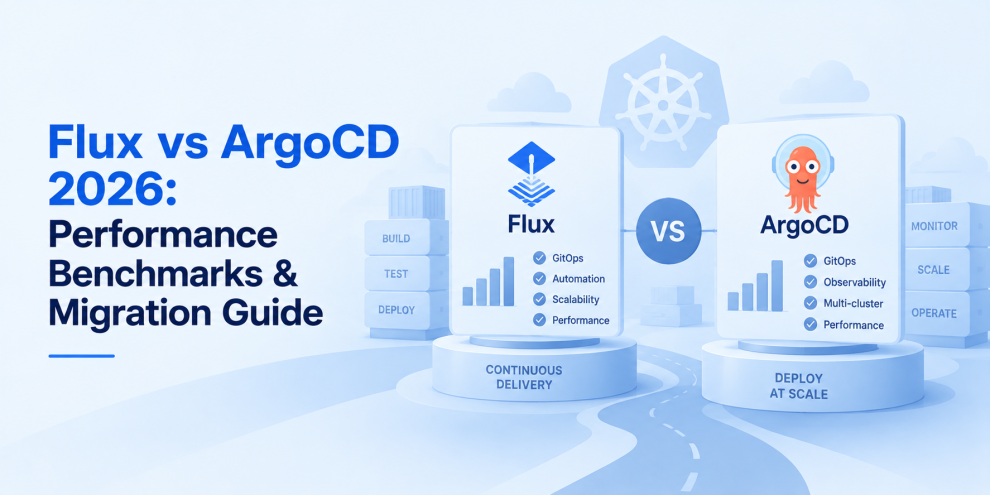

GitOps has become a core operating model for Kubernetes environments, but choosing a GitOps controller can become difficult as clusters, applications, and deployment workflows grow. Two of the most widely used options are Flux and Argo CD. Both continuously reconcile Kubernetes workloads against a desired state stored in Git, but they take different architectural approaches.
Flux is built around a collection of Kubernetes-native controllers such as source-controller, kustomize-controller, helm-controller, and notification-controller. Argo CD takes a more application-centric approach, providing an API server, application controller, repository service, CLI, and a built-in web interface. Both are CNCF Graduated projects, but their operational models are different enough that architecture, team workflow, and scale should all be considered before migrating.
Flux vs Argo CD: The Architectural Difference
The biggest difference is how each system represents and manages deployments.
Argo CD treats an application as the primary deployment object. An Application defines the source repository, destination cluster, synchronization behavior, and related configuration. Its API and web interface provide a centralized view of application health and synchronization state.
Flux uses multiple controllers that reconcile Kubernetes resources independently. A typical setup may use a GitRepository as the source, a Kustomization for manifest reconciliation, and a HelmRelease for Helm-based workloads.
This distinction affects everything from troubleshooting to scaling. Argo CD provides a centralized application management experience, while Flux fits more naturally into a Kubernetes-native, controller-oriented operating model.
Performance Is More Than Sync Speed
Comparing Flux and Argo CD based on a single synchronization time can be misleading.
GitOps performance depends on Git polling or webhook delivery, manifest retrieval, rendering, diff calculation, Kubernetes API operations, reconciliation concurrency, cluster size, network latency, repository structure, and the number of managed resources.
A better benchmark measures the complete deployment path.
Useful metrics include time from Git commit to reconciliation, reconciliation duration, CPU consumption, memory consumption, Kubernetes API requests, repository rendering time, failed synchronization rate, and recovery time after a controller restart.
This matters because a tool that performs well with 20 applications may behave very differently when managing hundreds or thousands.
Flux Performance Characteristics
Flux’s distributed controller architecture allows different responsibilities to be handled independently. Source retrieval, Kustomize processing, Helm reconciliation, and notifications are separated into controllers that can be configured and scaled according to workload requirements.
Flux also publishes its own Mean Time To Production benchmarks. For example, its current benchmark results test workloads involving 100, 500, and 1,000 application packages and report resource consumption and reconciliation durations for individual Flux controllers. The results demonstrate that workload size and controller type can materially affect performance.
This architecture can be attractive for platform teams that want granular control over individual reconciliation components rather than operating one centralized application-management layer.
Argo CD Performance Characteristics
Argo CD uses components including the application controller, repository server, API server, and Redis. Its centralized model makes application state and deployment status easier to inspect from one interface, but some workloads can place significant demand on components such as the repository server and application controller.
Large numbers of applications, complex Helm templates, large manifests, frequent synchronization, and multiple clusters can increase resource requirements.
Argo CD can scale its components, but teams should benchmark repository rendering, controller queues, API-server traffic, and Redis usage under their actual deployment patterns rather than relying on generic numbers.
What Published Benchmarks Actually Tell You
Community benchmarks published in 2026 report different results depending on their methodology. One comparison reported lower resource consumption for Flux at larger application counts, while another same-cluster experiment found Argo CD completing a particular forced synchronization faster because of its cached application state. These results are not contradictory: they measure different workloads and therefore should not be treated as universal performance rankings.
For a production DevOps team, the useful lesson is simple: benchmark the deployment pattern that actually matters to your organization.
Repository Structure Can Become a Bottleneck
GitOps performance is also influenced by how repositories are organized.
A repository containing thousands of unrelated manifests can create unnecessary processing work. Large Helm charts, deeply nested Kustomize overlays, excessive generated configuration, and inefficient environment structures can increase reconciliation time.
Before blaming Flux or Argo CD, review the repository itself.
Separating infrastructure from application configuration, reducing unnecessary manifest generation, and designing predictable environment overlays can improve GitOps performance regardless of the controller being used.
Webhooks vs Polling
GitOps systems need to detect changes in the desired state.
Polling introduces a delay between a Git change and reconciliation, while webhooks can trigger processing much sooner.
Both Flux and Argo CD support event-driven workflows, but the complete pipeline still matters. A webhook may arrive immediately while repository fetching, rendering, authorization, or Kubernetes API operations take additional time.
Therefore, measure Git commit-to-deployment latency rather than measuring only webhook delivery time.
Multi-Cluster Operations
Multi-cluster environments introduce another dimension to the comparison.
Argo CD provides a centralized application-management model that can be useful when platform teams need to observe and manage applications across multiple Kubernetes clusters.
Flux distributes its controllers within the environments being reconciled. This can fit organizations that prefer cluster-local GitOps control and Kubernetes-native configuration.
The decision becomes particularly important when clusters have different network boundaries, compliance requirements, team ownership models, or failure domains.
Security and Access Control
GitOps controllers have significant deployment authority, so security architecture should be part of the evaluation.
Argo CD provides its own authentication and authorization capabilities around its API and UI, including integration with identity providers.
Flux primarily operates through Kubernetes resources and Kubernetes RBAC, with access controlled through the Kubernetes security model.
Neither approach eliminates the need for careful repository permissions, secret management, service-account restrictions, network policies, and least-privilege design.
The GitOps controller should have only the permissions required to reconcile the resources it actually manages.
Developer Experience
Developer workflow can strongly influence the choice.
Argo CD provides a visual interface where developers and operators can inspect applications, synchronization state, health, differences, and deployment history.
Flux is more CLI and Kubernetes-resource oriented. Engineers comfortable with kubectl, Git, CRDs, and declarative configuration may prefer this model.
The difference is not simply about having a dashboard. It is about whether teams want GitOps to operate primarily as an application-management platform or as a collection of Kubernetes controllers.
Helm and Kustomize Workloads
Both tools support common Kubernetes configuration approaches, including Helm and Kustomize.
Flux uses dedicated controllers such as helm-controller and kustomize-controller. Argo CD can render and deploy Helm and Kustomize-based applications through its application model.
The important performance consideration is complexity. Large Helm charts, many dependencies, frequent updates, and complex Kustomize overlays can increase reconciliation work.
Benchmarking should therefore include the actual configuration technologies used by the organization rather than testing only a small Deployment manifest.
When Migration From Argo CD to Flux Makes Sense
A migration can make sense when an organization wants a more controller-oriented architecture, tighter integration with Kubernetes-native resources, or greater separation between different reconciliation responsibilities.
Flux also provides image automation components that can detect new container images and update deployment configuration through Git-based workflows.
However, migration should not be justified solely by claims that Flux is “faster.” The real question is whether its architecture better matches the organization’s operating model and workload.
When Migration From Flux to Argo CD Makes Sense
Teams may consider Argo CD when they need a centralized application-management experience, built-in visualization, application-level synchronization controls, or a common interface for teams managing many deployments.
Its Application and ApplicationSet models can simplify certain multi-environment and multi-cluster workflows.
Again, the migration decision should be based on operational requirements rather than a generic performance ranking.
A Practical Migration Strategy
A GitOps migration should not begin by replacing the controller across every production cluster.
Start with one representative non-critical application. Document the existing Git structure, Helm or Kustomize configuration, secrets workflow, synchronization policies, namespaces, service accounts, and deployment dependencies.
Then reproduce the workload in the target GitOps system.
Measure commit-to-deployment latency, reconciliation duration, controller resource consumption, deployment failure rate, rollback behavior, and recovery after controller or cluster failures.
Once the workflow is stable, migrate applications incrementally.
This approach also provides a controlled way to identify configuration differences before they affect critical workloads.
The Biggest Migration Risk Is Configuration Drift
GitOps migration can accidentally create two competing sources of truth.
Running Flux and Argo CD against the same resources without strict boundaries can result in controllers attempting to reconcile the same objects.
During migration, ownership should therefore be explicit.
A practical sequence is to select a workload, define its target controller, stop reconciliation by the old controller at the appropriate stage, validate the new controller’s desired state, and then monitor for unexpected changes.
The goal is to transfer ownership without creating a period where two systems believe they are responsible for the same resources.
Benchmark Before and After Migration
A proper migration benchmark should include more than deployment time.
Track Git-to-cluster latency, CPU and memory consumption, reconciliation queue depth, Kubernetes API activity, failed reconciliations, recovery time, deployment throughput, and operational effort.
Also test failure scenarios.
What happens when Git becomes unavailable? What happens when the Kubernetes API is slow? How quickly does the controller recover? Does it retry safely? Can operators identify the failure without manually reconstructing events?
These tests provide a much more useful picture of production performance than a single sync benchmark.
Where Engineering Teams Fit Into the Picture
GitOps migrations often involve more than installing a new controller. Repository architecture, Kubernetes configuration, CI/CD workflows, observability, security policies, deployment automation, and application ownership all need to remain consistent during the transition.
Engineering teams such as GeekyAnts, Thoughtworks, and other DevOps and platform engineering organizations work across these layers when modernizing Kubernetes delivery environments. The important part is treating the migration as an architecture change rather than simply replacing one deployment tool with another.
A Practical Flux vs Argo CD Decision Framework
The choice should start with operating requirements.
Teams that prioritize a centralized application-management interface may find Argo CD’s application model, API, and UI useful. Teams that prefer distributed Kubernetes controllers and Git-native reconciliation may find Flux’s architecture a closer fit.
Organizations with large multi-cluster environments should evaluate controller placement, network boundaries, repository structure, RBAC, failure domains, and operational ownership.
Performance-sensitive teams should benchmark both tools using their real application count, manifest complexity, repository structure, cluster topology, and synchronization frequency.
There is no universal benchmark number that can determine the right GitOps controller for every Kubernetes environment.
What DevOps Leaders Should Measure
Before adopting or migrating between Flux and Argo CD, teams should measure deployment latency, reconciliation duration, CPU and memory usage, Kubernetes API activity, Git polling or webhook latency, failure recovery, deployment throughput, and operator workload.
They should also evaluate security boundaries, multi-cluster management, repository architecture, rollback behavior, observability, and developer workflow.
The objective is not to select the tool with the smallest benchmark number. It is to identify the GitOps architecture that can reliably reconcile the organization’s workloads at its required scale.
The Future of GitOps Performance
As Kubernetes environments become larger and platform teams manage increasingly complex application fleets, GitOps performance will depend less on raw controller speed and more on architecture.
Repository design, reconciliation concurrency, workload distribution, event-driven updates, observability, resource sizing, and failure recovery all contribute to deployment performance.
Flux and Argo CD solve the same fundamental GitOps problem through different models. The most reliable way to compare them is to reproduce the organization’s real workloads, measure the complete deployment lifecycle, and evaluate operational behavior under both normal and failure conditions.
For DevOps teams in 2026, the better GitOps migration is therefore not the one based on a generic benchmark. It is the one backed by measurements from the Kubernetes environments the team actually operates.
For more, visit our homepage!





Add Comment