






Enterprise software delivery has entered a difficult phase. Development teams now generate code faster than most organizations can validate, secure, test, deploy, and recover from failures. The acceleration created by generative AI coding assistants has exposed weaknesses that already existed inside enterprise delivery pipelines.
For technology leaders managing engineering organizations across the United States, the issue is no longer developer productivity alone. The real challenge is maintaining release stability while deployment frequency increases across distributed platforms, cloud-native systems, APIs, and customer-facing digital products.
Industry research and enterprise engineering discussions increasingly suggest that while AI adoption across software teams is growing rapidly, release instability and operational friction remain significant concerns. Many platform leaders recognize a consistent pattern: AI tends to amplify existing engineering systems rather than automatically fixing them. Mature engineering organizations often move faster with AI, while fragmented organizations risk scaling operational issues more quickly.
That distinction matters for large enterprises managing complex infrastructure, customer-facing platforms, and continuous software delivery operations. In these environments, even minor deployment failures can trigger customer experience problems, compliance concerns, service disruptions, or revenue-impacting downtime.
This is where autonomous, self-healing CI/CD pipelines are becoming strategically relevant.
Why Enterprise Delivery Pipelines Are Under Pressure
Most large enterprises already invested heavily in DevOps modernization over the last decade. They adopted Kubernetes, infrastructure-as-code, GitOps workflows, automated testing frameworks, observability platforms, and cloud-native deployment models.
Yet many engineering executives still face the same operational issues:
- Flaky tests delaying releases
- Rollback decisions requiring manual approvals
- Security scans overwhelming engineering teams with false positives
- Incident recovery depending on tribal knowledge
- Platform teams becoming bottlenecks for every deployment
- Rising cloud costs caused by inefficient pipeline execution
- Developer productivity gains failing to consistently improve deployment reliability
The pressure has intensified because AI-assisted development is increasing code throughput across engineering teams. Many developers now use AI tools regularly for code generation, testing, documentation, and refactoring.
But faster code generation without adaptive operational systems creates a difficult imbalance.
Many enterprises now release software continuously across multi-cloud environments, edge systems, and customer applications that operate around the clock. Traditional CI/CD pipelines were designed to automate workflows. Autonomous pipelines are increasingly designed to support operational decision-making.
That difference is substantial.
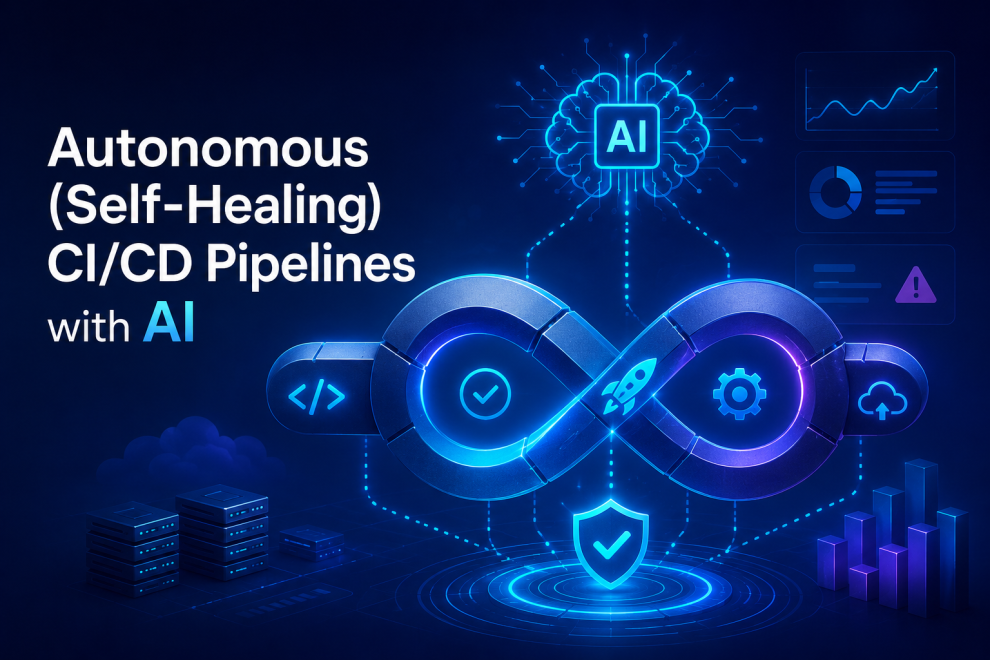
A self-healing pipeline can detect abnormal deployment behavior, identify likely causes, pause releases automatically, reroute workloads, trigger remediation scripts, initiate rollbacks, or escalate incidents without waiting for human intervention.
Instead of treating pipelines as passive automation workflows, enterprises are beginning to treat them as intelligent operational systems.
What “Self-Healing” Actually Means in Enterprise CI/CD
The term “self-healing pipeline” often gets overstated in vendor conversations. In practice, enterprise adoption is more measured and pragmatic.
Most organizations are not handing full release authority to AI agents. Instead, they are introducing bounded autonomy inside specific delivery stages.
Current enterprise implementations typically focus on four operational areas:
Predictive Failure Detection
AI models analyze historical deployment data, test results, infrastructure telemetry, and observability signals to identify high-risk deployments before production rollout.
Intelligent Remediation
Pipelines trigger predefined remediation workflows automatically when known failure patterns appear. This can include restarting services, reallocating infrastructure resources, isolating problematic microservices, or applying rollback policies.
Adaptive Testing and Validation
AI systems prioritize test execution based on code-change risk, reducing pipeline duration while maintaining validation coverage.
Autonomous Incident Response
Integrated observability and AIOps systems correlate logs, traces, infrastructure events, and deployment metadata to accelerate root-cause analysis.
This operational shift is becoming increasingly relevant because software quality and security risks are growing concerns as organizations accelerate deployment velocity with AI-assisted development.
For engineering leaders, the operational question is no longer whether AI belongs inside the delivery pipeline. The more important question is where autonomous decision-making should stop.
AI Pipelines Need Governance More Than Hype
Many enterprise AI initiatives stall because leadership teams focus too heavily on tooling instead of delivery architecture.
The strongest engineering organizations are not necessarily adopting the most aggressive AI automation strategies. They are building structured governance around platform engineering, observability, release policies, and operational accountability.
Industry research continues to show that AI effectiveness depends heavily on organizational maturity, version control discipline, internal platform quality, and cross-functional alignment.
In practical terms, enterprise engineering leaders increasingly need:
- Policy-driven deployment controls
- Human-in-the-loop escalation layers
- AI auditability for release decisions
- Traceable rollback governance
- Unified telemetry across engineering and operations
- Standardized golden paths for internal developer platforms
- Platform teams capable of operating AI-assisted infrastructure at scale
This is also why many large organizations are shifting investment toward platform engineering and internal developer experience initiatives rather than relying solely on standalone AI coding tools.
Enterprise leaders are starting to recognize that autonomous CI/CD is less about replacing engineers and more about reducing operational drag.
The highest-performing engineering teams still rely heavily on human oversight for architectural decisions, customer-impact analysis, compliance review, and production governance. AI performs best when handling repetitive operational coordination tasks that traditionally slow down release engineering.
The Enterprise Opportunity Over the Next 18 Months
Over the next 12 to 18 months, large enterprises will likely divide into three groups.
The first group will continue experimenting with isolated AI coding assistants while operational bottlenecks remain largely unchanged.
The second group will automate portions of release engineering but struggle with fragmented governance and inconsistent platform standards.
The third group will operationalize AI across the broader software delivery lifecycle through integrated platform engineering strategies.
That final group will likely gain measurable advantages in deployment frequency, recovery speed, operational resilience, and developer efficiency.
For engineering executives, the priority is not building fully autonomous software factories overnight. The more realistic goal is reducing operational friction in areas where teams repeatedly lose time, reliability, and engineering focus.
That includes:
- Reducing mean time to recovery (MTTR)
- Improving deployment confidence
- Minimizing rollback frequency
- Shortening incident triage cycles
- Lowering platform support overhead
- Improving customer-facing uptime
- Scaling release operations without proportionally scaling platform teams
Organizations pursuing these outcomes increasingly work with engineering partners that understand both AI-enabled delivery systems and enterprise-grade platform modernization. In many cases, companies are looking beyond pure consulting models and engaging product engineering teams that can operate across frontend platforms, cloud infrastructure, developer experience, and AI-assisted operational workflows.
This broader shift explains why engineering-focused firms such as GeekyAnts are appearing more frequently in enterprise modernization discussions around scalable digital platforms, developer productivity systems, and experience-led engineering transformation.
The conversation is becoming less about AI experimentation and more about operational resilience.
That is ultimately why autonomous CI/CD pipelines matter.
The enterprises that succeed with self-healing delivery systems will not necessarily be the organizations with the most AI tools. They will be the ones that combine AI-assisted automation with disciplined engineering governance, resilient platform architecture, and operational visibility across the software delivery lifecycle.
For enterprises managing constant release pressure, that combination may become one of the most important competitive advantages in modern software delivery.


Add Comment