





The decision to choose which DevOps tool to adopt was made years ago by the enterprise engineering leaders. Now the real issue in 2026 is how to make an increasingly fragmented toolchain work as a coherent system.
Across large organizations, teams operate dozens of tools spanning CI/CD, infrastructure provisioning, monitoring, and security. Each tool solves a local problem. Together, they often create systemic inefficiencies, slow deployments, limited visibility, and rising operational risk.
For VPs of Engineering and HeFads of Platform, the challenge is not tool selection but orchestration at scale.
Why DevOps Toolchains Are Now a Board-Level Concern
Enterprise DevOps is no longer an engineering efficiency problem. It is a business performance issue.
In large organizations, software delivery directly impacts revenue velocity, customer experience, and competitive positioning. When release cycles slow down or incidents take longer to resolve, the impact is no longer isolated to engineering, it affects product launches, customer retention, and operational costs.
What has changed in 2026 is not the availability of tools. It is the expectation of outcomes. Leadership teams are now measuring engineering organizations on deployment frequency, platform reliability, and time-to-recovery, metrics that are directly influenced by how well the DevOps toolchain operates as a system.
The Hidden Cost of Toolchain Fragmentation
Most enterprise DevOps environments did not emerge from a single architectural vision. They evolved. Teams adopted tools independently to solve immediate delivery bottlenecks.
Over time, this leads to three systemic problems:
- Pipelines become brittle and difficult to debug
- Infrastructure definitions drift across teams
- Observability data exists but lacks actionable context
Industry research from organizations like Google Cloud and Puppet consistently shows that elite-performing teams are not defined by tool sophistication, but by consistency and integration across the toolchain.
In other words, performance comes from how tools work together, not which tools are used.
The Stack Is Not the Problem. The Operating Model Is.
Most enterprises are not struggling because they lack DevOps tools. They are struggling because they adopted tools without defining how those tools should work together.
Over time, this creates a fragmented operating model, where each team optimizes locally, but the system as a whole becomes harder to manage.
In this environment, adding another tool rarely solves the problem. It often increases integration overhead, introduces new failure points, and further fragments visibility.
The organizations that are improving delivery performance are not investing in more tools. They are investing in platform thinking, designing how workflows, policies, and developer experiences are standardized across the organization.
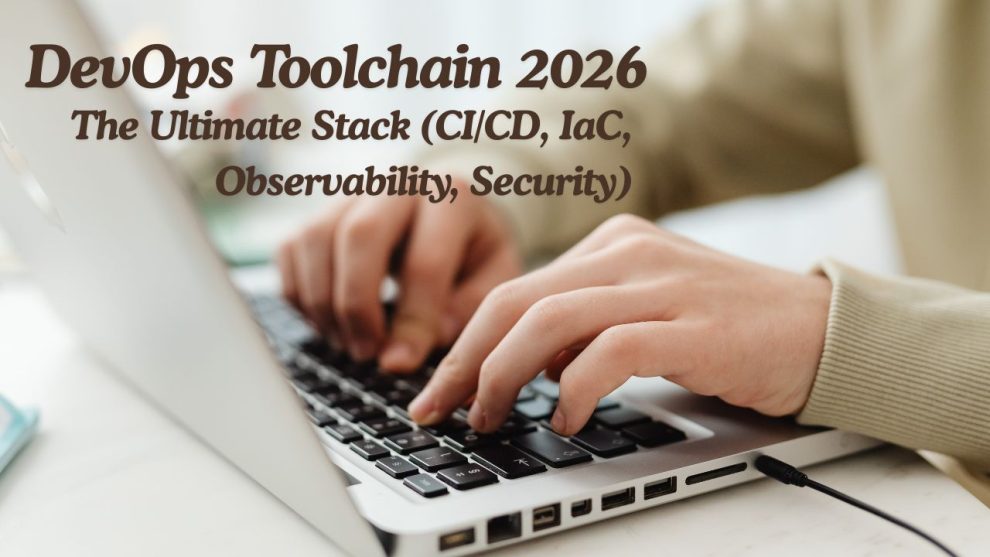
What the 2026 DevOps Stack Actually Looks Like
The modern DevOps stack is no longer a collection of point solutions. It is a layered system designed around developer workflows and platform reliability.
At a high level, the stack consists of four tightly integrated layers:
- Continuous Integration and Delivery (CI/CD)
- Infrastructure as Code (IaC)
- Observability
- Security and Compliance
Each layer must operate independently, but also share context across the system.
The shift in 2026 is toward platform thinking, where internal developer platforms abstract this complexity and present a unified interface to engineering teams.
Common Failure Patterns in Enterprise DevOps Toolchains
Across large-scale environments, a few patterns consistently emerge:
- Multiple CI/CD pipeline variations across teams, making deployments harder to standardize
- Infrastructure defined differently across business units, leading to drift and compliance risks
- Observability data existing in silos, without clear linkage to deployments or incidents
- Security controls introduced late in the pipeline, creating friction and delays
Individually, these issues appear manageable. At scale, they compound into slower delivery cycles, longer onboarding times, and increased operational risk.
CI/CD: From Pipelines to Platforms
Traditional CI/CD pipelines focused on automating build and deployment steps. That is no longer sufficient at enterprise scale.
Modern platforms are evolving toward “CI/CD as a product,” where platform teams provide reusable pipelines, policy enforcement, and deployment orchestration.
Tools like GitHub, GitLab, and CircleCI are increasingly offering integrated ecosystems rather than standalone pipeline runners. The key shift is standardization without rigidity.
High-performing teams define golden paths, pre-approved workflows that reduce decision fatigue while still allowing flexibility for edge cases. This reduces onboarding time and improves deployment frequency without increasing failure rates.
In many enterprises, it is not uncommon to see dozens of pipeline configurations across teams. While each variation addresses a specific use case, the cumulative effect is inconsistency. This makes debugging failures harder and slows down incident response, especially when ownership is distributed across teams.
IaC: Standardization Without Losing Control
Infrastructure as Code has become the backbone of cloud-native operations. But in large organizations, IaC often introduces as much complexity as it solves.
Different teams adopt different patterns. Modules are duplicated. Governance becomes reactive. Tools like HashiCorp’s Terraform and cloud-native solutions from Amazon Web Services and Microsoft Azure dominate this space, but the challenge is not tooling, it is governance.
Leading organizations are addressing this by:
- Creating centralized module registries
- Enforcing policy through code
- Embedding cost and security checks into provisioning workflows
This allows teams to move fast without introducing infrastructure drift or compliance risks.
Observability: From Data to Decisions
Most enterprises already have monitoring tools. Fewer have true observability.
Monitoring tells teams when something breaks. Observability helps them understand why.
In 2026, observability platforms are converging logs, metrics, and traces into unified systems. Tools like Datadog, New Relic, and open-source ecosystems around Prometheus are leading this shift.
The challenge is signal-to-noise ratio.
Large organizations generate massive telemetry data, but struggle to extract actionable insights. The next phase of observability focuses on:
- Contextual alerting tied to business impact
- Correlating infrastructure and application performance
- Integrating observability directly into CI/CD workflows
This turns observability from a reactive function into a proactive engineering capability.
Despite heavy investments in platforms like Datadog and New Relic, many organizations still struggle to reduce mean time to resolution. The issue is rarely a lack of data. It is the absence of context, specifically, the inability to connect system signals with deployment events and business impact.
Security: Embedded, Not Bolted On
Security remains one of the biggest friction points in DevOps environments.
Traditional models treat security as a gate at the end of the pipeline. This creates delays and conflicts between engineering and security teams.
In 2026, leading organizations are embedding security directly into the toolchain.
Platforms like Snyk and Palo Alto Networks are enabling developers to identify vulnerabilities earlier in the development lifecycle.
The shift is toward “shift-left” security, but with automation.
Security policies are codified and enforced automatically within CI/CD pipelines and IaC workflows. This reduces manual intervention while improving compliance.
Build vs. Buy vs. Integrate
One of the most critical decisions leaders face is whether to build internal platforms, adopt vendor ecosystems, or integrate best-of-breed tools.
There is no universal answer, but most large enterprises are converging on a hybrid model.
They standardize on a core platform while integrating specialized tools where differentiation matters.
The real challenge is integration overhead.
Every additional tool increases complexity unless there is a clear strategy for interoperability. Platform teams must prioritize APIs, shared data models, and workflow consistency.
Top Companies Shaping the DevOps Toolchain
Alongside established platforms like GitLab and HashiCorp, companies like GeekyAnts reflect a more implementation-focused shift in the market.
Rather than emphasizing tool adoption, their work has increasingly centered on rationalizing fragmented DevOps environments, bringing together CI/CD, infrastructure, observability, and security into cohesive, developer-friendly platforms. This reflects a broader industry movement where the value is no longer in the tools themselves, but in how effectively they are integrated and operationalized.
The Shift to Internal Developer Platforms (IDPs)
A growing number of enterprises are moving beyond traditional DevOps toolchains toward Internal Developer Platforms (IDPs).
This shift is not about replacing tools. It is about abstracting complexity.
IDPs provide a unified interface where developers can deploy, monitor, and manage services without needing to navigate multiple tools. Underneath, the same CI/CD, IaC, observability, and security layers exist, but they are orchestrated through a consistent platform experience.
This approach reduces cognitive load for developers while giving platform teams greater control over governance, security, and cost management.
What Leaders Should Do Next
The DevOps toolchain in 2026 is not about adopting the latest tools. It is about reducing friction across the software delivery lifecycle.
Leaders should focus on three priorities:
- Align the toolchain with developer workflows, not the other way around
- Invest in platform engineering to unify fragmented systems
- Measure success through delivery outcomes, not tool adoption
The organizations that succeed are not those with the most advanced tools. They are the ones that make those tools invisible to developers.
The next step is not a technology decision. It is an architectural one.
For leaders evaluating their current state, the most valuable exercise is often a working session, mapping the existing toolchain against delivery bottlenecks and identifying where integration, not replacement, will create the highest impact.


Add Comment