



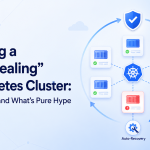

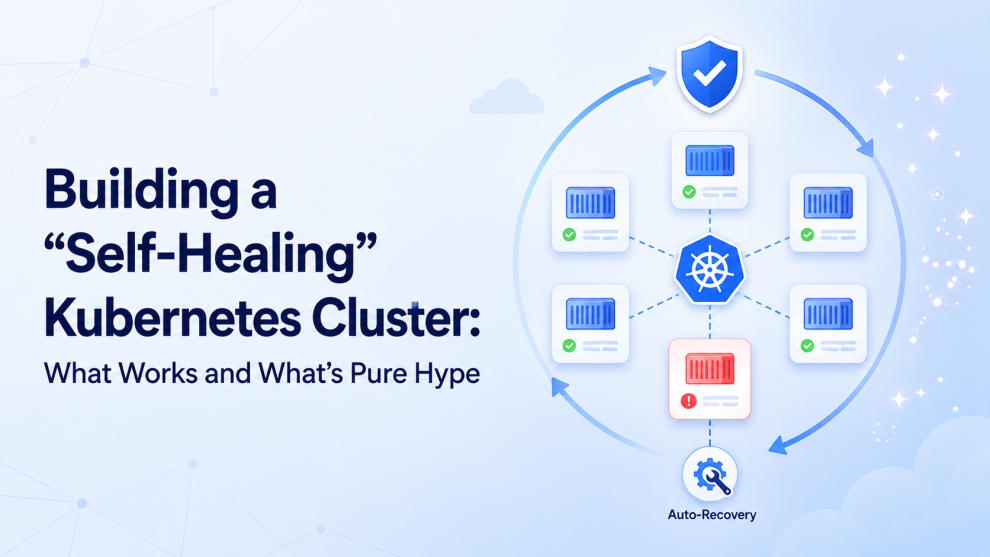

Kubernetes is often described as a self-healing platform, but that phrase can mean very different things depending on what is actually being automated. Kubernetes already handles several forms of recovery: failed containers can be restarted, failed Pods can be replaced, workloads can be rescheduled when nodes become unavailable, and unhealthy Pods can be removed from Service traffic. The harder problem is everything beyond those predefined control loops. A production cluster still needs to deal with bad deployments, cascading failures, dependency problems, resource exhaustion, configuration errors, noisy neighbors, and application-level defects. This is where the idea of AI-powered self-healing becomes interesting, but also where much of the current hype needs to be separated from what is actually reliable.
What Kubernetes Already Heals
The first misconception is that self-healing requires AI. It does not. Kubernetes was designed around reconciliation and desired state. If a container fails, the kubelet can restart it according to its restart policy. If a Pod managed by a Deployment or StatefulSet disappears, controllers can create a replacement. If a node becomes unavailable, workloads can be rescheduled where appropriate. Kubernetes can also remove unhealthy Pods from Service traffic when readiness checks fail.
These mechanisms are powerful because they are deterministic. The system does not need to guess what should happen. The desired state is already defined, and Kubernetes continuously works toward that state.
Health Probes Are Useful, but They Are Not Intelligence
Liveness, readiness, and startup probes are among the most practical self-healing mechanisms available in Kubernetes. A liveness probe can trigger a container restart when an application becomes unhealthy, while a readiness probe can prevent traffic from reaching a Pod that is temporarily unable to serve requests. Startup probes help prevent slow-starting applications from being incorrectly restarted before initialization has completed.
The important distinction is that probes detect defined conditions. They do not understand why an application is failing. An incorrectly configured liveness probe can actually make reliability worse by repeatedly restarting workloads under high load and contributing to cascading failures. Kubernetes documentation explicitly warns about this risk.
For platform engineering teams, the lesson is straightforward: health checks should represent meaningful application health, not simply whether a process is responding.
What Actually Works
The most reliable form of Kubernetes self-healing combines native Kubernetes mechanisms with carefully designed automation. Replica management, health probes, workload controllers, autoscaling, disruption controls, automated rollouts, and workload-specific Operators can handle many predictable failure scenarios.
Operators are particularly useful because they extend Kubernetes with application-specific control loops. An Operator can encode operational knowledge that would otherwise require a human, such as restoring a database, performing a controlled upgrade, managing application configuration, or responding to a known service condition. Kubernetes describes the Operator pattern as a way to automate repeatable operational tasks using controllers and custom resources.
This is real self-healing because the system has explicit knowledge of the desired state and the remediation procedure.
Where AI Can Add Real Value
AI becomes more useful when the problem is not simply “restart this Pod” but “determine what is actually causing this failure.”
Consider a production API whose latency suddenly increases. CPU utilization may remain normal, but database connections are approaching their limit, error rates are rising between two services, and the latest deployment changed connection-pool settings. Traditional automation can respond to individual signals. An AI-assisted operations layer could correlate these signals and identify a likely relationship between the deployment and the database connection behavior.
That does not mean AI should immediately change the production configuration. A safer architecture uses AI for anomaly detection, event correlation, root-cause analysis, remediation recommendations, and prioritization, while deterministic automation handles approved actions.
The Right Architecture for AI-Assisted Self-Healing
A production architecture can be structured as Telemetry → Detection → Correlation → Diagnosis → Policy → Remediation → Verification.
The telemetry layer collects metrics, logs, traces, Kubernetes events, application health signals, and infrastructure data. The detection layer identifies anomalies. The correlation layer connects events across services and workloads. The AI diagnosis layer evaluates possible causes and recommends an action. The policy layer determines whether that action is allowed. The remediation layer executes a predefined procedure, while the verification layer checks whether the system actually recovered.
This separation is critical. AI should not have unrestricted control over production infrastructure.
What Is Mostly Hype?
The idea that an AI agent can autonomously observe an entire Kubernetes cluster, understand every failure, modify infrastructure, and reliably restore production without human oversight is still far more ambitious than most organizations should assume.
AI can struggle with incomplete telemetry, ambiguous symptoms, changing application behavior, and situations where several failures happen simultaneously. A model may also produce a plausible explanation that is incorrect. Giving such a system unrestricted permissions to delete Pods, change resource limits, modify networking, roll back deployments, or alter configuration can turn a recovery mechanism into a new source of incidents.
The phrase “fully autonomous Kubernetes operations” therefore deserves skepticism unless the system has strong boundaries, reliable verification, and a clear rollback strategy.
The Safest Form of Autonomous Remediation
The best starting point is bounded autonomy. Give automation permission to handle specific, well-understood scenarios where the remediation is reversible and the expected outcome is measurable.
Examples include restarting a known unhealthy workload, scaling a service within approved limits, removing a failed Pod from traffic, restarting a stuck worker, triggering a predefined rollback, or executing a documented recovery workflow.
For uncertain incidents, AI should recommend rather than execute. A human can review the proposed action, approve it, and allow the automation layer to perform the change.
Over time, organizations can expand autonomy based on measured success rather than assuming that more AI automatically means better reliability.
Verification Is the Missing Piece
A self-healing system should never stop at remediation. After taking action, it needs to verify whether the system recovered.
Suppose an AI system identifies a memory-related failure and restarts a workload. If memory usage immediately climbs again, the restart did not solve the underlying problem. The system should recognize that the remediation failed and escalate the incident rather than repeatedly restarting the same workload.
This creates an important operational loop: Detect → Diagnose → Remediate → Verify → Escalate if Necessary.
Verification should consider service health, latency, error rates, dependency availability, resource consumption, and customer-facing impact rather than relying on a single Pod status.
Build for Failure Instead of Chasing Perfect Autonomy
A mature Kubernetes strategy does not attempt to make every failure automatically disappear. It focuses on reducing the frequency, duration, and impact of failures.
That means designing applications that tolerate Pod replacement, using appropriate disruption policies, creating meaningful health checks, making services observable, implementing safe deployment strategies, and ensuring that stateful systems have explicit recovery procedures.
Self-healing should therefore be viewed as a spectrum rather than a binary capability. Kubernetes handles predictable infrastructure conditions well. Operators can automate application-specific recovery. AI can add contextual analysis and decision support. Humans remain responsible for ambiguous, high-impact, and novel incidents.
A Practical Roadmap for Engineering Leaders
Organizations evaluating AI-powered Kubernetes operations should start with the failure scenarios that consume the most engineering time. Measure how frequently they occur, how they are currently detected, what remediation engineers perform, and whether that remediation is reversible.
Next, automate the deterministic parts using Kubernetes controllers, Operators, deployment automation, and policy controls. Add AI where correlation or diagnosis requires broader context. Finally, introduce autonomous remediation gradually, starting with low-risk actions and requiring verification after every intervention.
This approach provides a much stronger foundation than simply connecting an AI agent to a Kubernetes API and giving it broad permissions.
Where Engineering Partners Add Value
Building a reliable self-healing Kubernetes environment requires more than deploying an AI model. It involves Kubernetes architecture, backend engineering, observability, infrastructure automation, security policies, deployment strategies, and operational governance. Teams such as GeekyAnts and Thoughtworks can contribute across these areas when organizations are designing modern backend platforms and exploring AI-assisted reliability engineering.
The Real Meaning of a Self-Healing Cluster
Kubernetes is already self-healing in several important ways. The real opportunity is to extend those deterministic control loops with better observability, application-specific automation, and carefully governed AI assistance.
The strongest architecture is not one where AI controls everything. It is one where each layer handles what it is best suited for: Kubernetes reconciles desired state, health checks identify defined failure conditions, Operators automate known operational procedures, AI correlates complex signals and supports diagnosis, policy controls determine what can happen automatically, and humans remain in the loop for high-risk decisions.
That is what production-grade self-healing looks like. Less magic, more controlled automation, measurable recovery, and a clear boundary between what Kubernetes can reliably fix and what still requires engineering judgment.
For more, visit our homepage!


Add Comment