







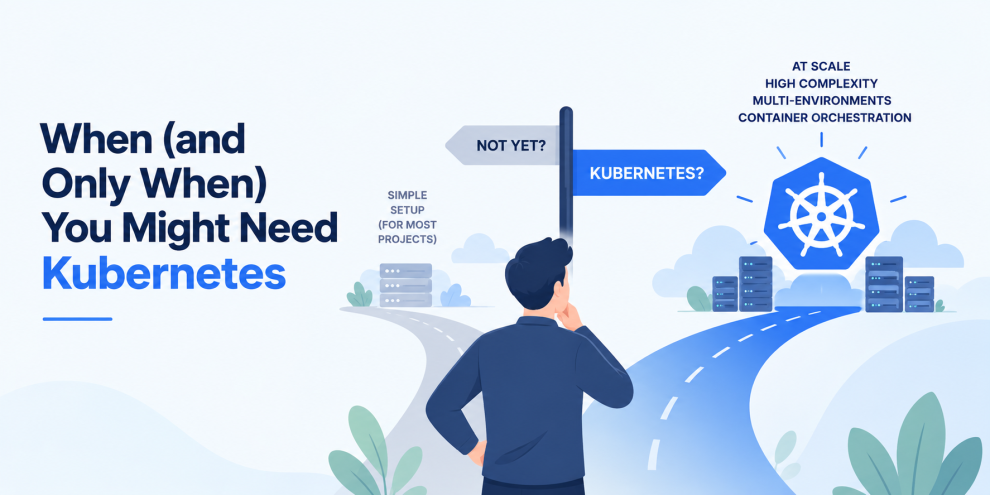

Kubernetes has become almost synonymous with modern application infrastructure. Mention containers, microservices, scaling, or production workloads, and Kubernetes is often the first technology that enters the conversation. But there is a problem with treating it as the default answer: not every application has a Kubernetes problem.
Kubernetes is powerful. It can automate deployment, scaling, service discovery, workload management, and application recovery across containerized environments. But that power comes with operational complexity. The real question is not whether Kubernetes can run your application. It almost certainly can. The better question is whether your application is complex enough to justify running Kubernetes in the first place.
Kubernetes Is a Solution to a Specific Problem
At its core, Kubernetes is designed to manage containerized workloads at scale. It becomes valuable when manually managing containers, deployments, replicas, networking, updates, and recovery starts becoming a problem.
For example, imagine an application with multiple services that need to run across several machines. Traffic changes throughout the day. New versions need controlled rollouts. Some workloads need to scale independently. If one instance fails, another should take its place automatically.
That is where Kubernetes starts making sense.
Kubernetes provides declarative workload management, allowing teams to describe the desired state of an application while the platform works to maintain that state. Deployments, for example, can gradually replace running Pods during an update rather than forcing every instance to change simultaneously.
But if your application is a small API running on one server with predictable traffic, introducing Kubernetes may solve a problem you do not actually have.
When You Probably Do Not Need Kubernetes
The easiest way to understand Kubernetes is to start with the cases where it may be unnecessary.
If you have a small application, a limited number of services, predictable traffic, and a team that does not need complex deployment orchestration, simpler infrastructure may be a better choice.
A managed application platform, virtual machine, container service, or straightforward deployment pipeline can often provide everything required without introducing cluster management.
This is particularly important for small teams. Kubernetes does not remove operational work. It changes the kind of operational work you have to do. Teams still need to think about networking, security, observability, upgrades, resource allocation, configuration, access control, and cluster reliability.
The Kubernetes documentation itself points out that production environments require considerably more planning than learning or development environments, particularly around availability, scaling, security, and cluster management.
Your Application Has Outgrown Simple Deployment
There is a point where a simple deployment model begins to feel restrictive.
Maybe the application has grown from one service to several independently deployed services. Maybe different components have very different resource requirements. Perhaps deployments are becoming difficult to coordinate, or application instances need to scale independently.
This is one of the situations where Kubernetes starts becoming compelling.
Instead of manually managing every running container, Kubernetes provides higher-level workload resources that manage Pods and continuously work toward the state you define.
The important distinction is that Kubernetes should enter the architecture because the application’s operational requirements have become complicated, not simply because the application uses containers.
You Need More Predictable Scaling
Scaling is another strong reason to consider Kubernetes.
A workload that receives relatively stable traffic may not need sophisticated orchestration. But applications with significant changes in demand can benefit from infrastructure that is designed around dynamic workloads.
Consider a platform where traffic increases sharply during certain periods. Running a fixed number of application instances may waste resources during quiet periods while becoming insufficient during peaks.
Kubernetes provides mechanisms for managing workloads across multiple nodes and supporting scaling strategies. Its production guidance specifically highlights changing demand and the need to plan capacity accordingly.
But again, scale alone does not automatically mean Kubernetes. The question is whether the scaling problem is complex enough to justify the additional operational layer.
You Have Multiple Services With Different Needs
Kubernetes becomes increasingly useful when an application stops behaving like one application.
A modern platform might contain APIs, background workers, scheduled jobs, event processors, internal services, and other workloads. These components may need different deployment schedules, resource allocations, scaling behavior, and availability requirements.
Managing all of that manually can become difficult.
Kubernetes provides workload abstractions for different types of applications, including long-running services, batch workloads, and scheduled jobs.
This is where Kubernetes can shift from being an additional layer to becoming an organizational layer for the application itself.
You Need Controlled Deployments
Another reason to adopt Kubernetes is when deployment reliability becomes a major concern.
A production system may need gradual rollouts, controlled replacement of application instances, automated recovery, and the ability to roll back changes when something goes wrong.
Kubernetes Deployments support controlled updates by gradually scaling new Pods up while scaling old ones down.
That does not mean Kubernetes automatically makes deployments safe. Poor configuration, insufficient testing, weak observability, or bad release practices can still cause incidents.
Kubernetes provides mechanisms. Engineering practices determine whether those mechanisms are used effectively.
You Need Infrastructure Portability
Kubernetes can also make sense when portability matters.
Organizations may need to operate applications across different environments, including public infrastructure, private infrastructure, or multiple providers. Kubernetes provides a common platform for running containerized workloads across these environments.
However, portability should be treated carefully.
Moving an application between environments is not automatically simple just because Kubernetes is involved. Storage, networking, identity, monitoring, security controls, and provider-specific services can still create dependencies.
Kubernetes can provide a useful common layer, but it does not magically eliminate infrastructure differences.
Kubernetes Is Not a Shortcut to Better Architecture
One of the biggest misconceptions is that adopting Kubernetes automatically makes an architecture modern.
It does not.
A poorly designed application can run perfectly well inside a Kubernetes cluster while remaining poorly designed.
Kubernetes cannot fix excessive service coupling, inefficient APIs, weak database design, missing observability, bad deployment practices, or unclear ownership boundaries.
In fact, introducing Kubernetes too early can make those problems harder to understand because there are now more infrastructure layers involved.
The goal should never be to make the architecture look sophisticated. The goal should be to make the system easier to operate as its requirements become more sophisticated.
The Operational Cost Matters
Before adopting Kubernetes, teams should calculate more than infrastructure costs.
There is also the cost of engineering time.
Someone needs to understand the cluster. Someone needs to maintain it. Someone needs to monitor it. Someone needs to handle upgrades, security, resource allocation, networking, failures, and troubleshooting.
Teams can reduce some of this burden by using managed Kubernetes services, but the operational model still needs to be understood. Kubernetes documentation explicitly recommends considering how much cluster management you want to handle yourself versus handing off to a provider.
That decision can be just as important as the decision to use Kubernetes itself.
The Team Matters More Than the Technology
A technically suitable architecture can still be the wrong architecture for a team.
If a small development team has limited infrastructure experience and operates a relatively simple application, Kubernetes may create more operational overhead than value.
On the other hand, a platform team responsible for dozens of services, multiple environments, frequent releases, and changing workloads may benefit enormously from Kubernetes.
The technology should match the team’s operational maturity.
Where Engineering Experience Becomes Important
The decision to introduce Kubernetes should come from architecture requirements rather than technology trends. This is where experienced engineering teams can help determine whether Kubernetes genuinely solves an operational problem or simply adds another layer to the stack.
For teams evaluating container orchestration, GeekyAnts can help assess application architecture, deployment requirements, scalability needs, and operational complexity before Kubernetes becomes part of the solution. The important part is not adopting Kubernetes for the sake of modernization, but choosing the infrastructure model that fits the application’s actual requirements.
A Simple Kubernetes Decision Test
Before adopting Kubernetes, ask a few straightforward questions.
Does the application have multiple independently managed workloads? Does traffic change significantly? Do different services require different scaling behavior? Are deployments becoming difficult to manage? Do you need automated workload recovery? Does your team need a consistent platform across multiple environments? Do you have the expertise to operate Kubernetes, or a managed option that reduces that responsibility?
If most answers are no, Kubernetes may be unnecessary.
If several answers are yes, it may be worth evaluating.
And if the answer is somewhere in between, start small. Containerize the application, understand the operational requirements, and introduce orchestration only when the complexity justifies it.
The Best Kubernetes Architecture Might Be No Kubernetes
Kubernetes is not inherently better than simpler infrastructure.
It is better when its capabilities solve problems that simpler approaches cannot solve efficiently.
That distinction matters because infrastructure complexity has a cost. Every additional platform introduces new concepts, tools, failure modes, security considerations, and operational responsibilities.
The best architecture is therefore not the one with the most sophisticated technology. It is the one that provides the capabilities the application actually needs without creating unnecessary complexity.
Sometimes that architecture includes Kubernetes.
Sometimes it does not.
And knowing the difference is a much more valuable engineering skill than simply knowing how to deploy an application to a cluster.
Frequently Asked Questions
When should a company use Kubernetes?
Kubernetes is most useful when applications have multiple containerized workloads, changing demand, complex deployment requirements, or a need for automated workload management and scaling.
Is Kubernetes necessary for microservices?
No. Microservices can run without Kubernetes. Kubernetes becomes useful when the number and operational complexity of those services make manual management increasingly difficult.
Is Kubernetes overkill for a small application?
Often, yes. A small application with predictable traffic and simple deployment requirements may be better served by a simpler hosting or container platform.
Does Kubernetes reduce operational complexity?
It can reduce certain types of operational work by automating workload management, deployment, scaling, and recovery. However, running Kubernetes introduces its own operational responsibilities.
Should startups use Kubernetes from the beginning?
Not necessarily. Startups should first understand their application and operational requirements. Kubernetes can be introduced when scaling, deployment, or workload-management needs justify its complexity.
Is managed Kubernetes easier to operate?
Managed Kubernetes can reduce some cluster-management responsibilities because the provider handles parts of the control plane and infrastructure. Teams still need to understand workloads, security, networking, configuration, monitoring, and resource management.
What is the biggest mistake when adopting Kubernetes?
The biggest mistake is treating Kubernetes as a default requirement for modern applications rather than evaluating whether its capabilities solve a real operational problem.
For more, visit our homepage!



Add Comment