









Getting a machine learning model to work in a notebook is no longer the hard part. The difficult part begins when that model becomes part of a production application. A model that performs well during development can behave very differently after deployment. Training data changes. Production traffic looks different from test traffic. Features arrive late. Model dependencies become difficult to reproduce. Inference infrastructure becomes expensive. New model versions introduce unexpected regressions. Monitoring detects infrastructure failures but misses declining model quality.
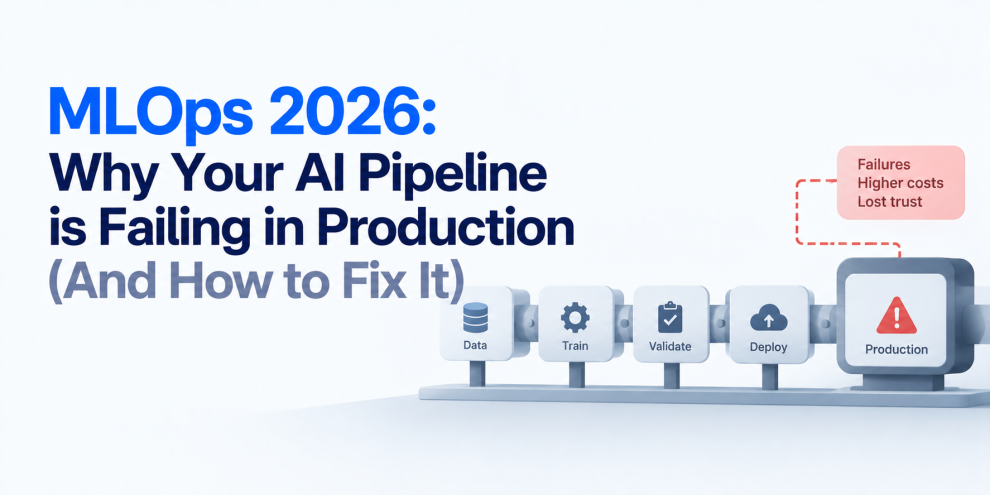
This is where MLOps becomes an engineering discipline rather than a collection of machine learning tools. In 2026, production AI systems increasingly combine traditional machine learning, generative AI, retrieval systems, APIs, feature pipelines, GPUs, data platforms, and automated deployment workflows. The result is a system where model reliability depends on much more than the model itself. The question is no longer simply whether a model is accurate. It is whether the entire AI pipeline can reliably move from data to training, validation, deployment, inference, monitoring, retraining, and rollback without becoming an operational liability.
Why AI Pipelines Fail After Deployment
Many AI projects follow a familiar pattern. Data scientists prepare a dataset, train a model, evaluate it against a test set, and demonstrate impressive results. The model is then handed to an engineering team for production deployment. That transition is where problems often appear. The production environment may contain different data distributions, higher traffic volumes, missing features, unexpected inputs, different hardware, stricter latency requirements, and dependencies that were not present during experimentation.
A model can therefore remain technically available while becoming operationally unreliable. This creates an important distinction between model performance and production performance. A model might achieve excellent validation accuracy while generating poor business outcomes because the data reaching it in production no longer resembles the training data.
MLOps Is Bigger Than Model Deployment
MLOps is sometimes reduced to deploying models through a CI/CD pipeline. Production AI requires considerably more. A complete MLOps environment may include data ingestion, validation, feature engineering, training pipelines, experiment tracking, model registries, evaluation, deployment, inference infrastructure, monitoring, drift detection, retraining, security, and governance.
Each stage introduces potential failure points. A data pipeline can fail before training begins. A training environment can produce a model that cannot be reproduced later. A deployment can introduce latency problems. A model can drift after several months. An automated retraining process can produce a technically valid but operationally worse model. The pipeline therefore needs to be treated as a production system in its own right.
Data Quality Is a Production Dependency
A model is only as reliable as the data it receives. Production data can contain missing values, malformed records, unexpected categories, stale features, duplicate events, incorrect timestamps, or changes in upstream systems. These problems can be particularly difficult to detect because the application itself may continue functioning normally. An API can return HTTP 200 responses while the model is making increasingly poor predictions.
Production data validation should therefore happen before data reaches critical model stages. Teams should monitor data completeness, schema changes, feature distributions, missing values, outliers, freshness, and unexpected categorical values. Data quality should be treated with the same seriousness as application availability.
Training Must Be Reproducible
Another common production failure occurs when teams cannot reliably reproduce the model they deployed. A model may depend on a specific dataset version, feature transformation, Python package, framework version, training configuration, random seed, GPU environment, or preprocessing pipeline. If those dependencies are not captured, rebuilding the model months later can produce a different result.
Production MLOps should therefore version more than the model file. Teams should track dataset versions, source code, feature definitions, dependency versions, training parameters, experiment metadata, model artifacts, evaluation results, and deployment configuration. The objective is simple: an engineer should be able to understand how a production model was created and reproduce the relevant environment when necessary.
The Model Registry Needs to Become a Release System
A model registry should not simply act as a storage location for model files. It should provide a controlled path from experimentation to production. A production-oriented model lifecycle can look like: Experiment → Evaluation → Candidate Model → Approval → Staging → Production → Monitoring → Retirement.
Each model version should have associated metadata covering its training data, evaluation results, configuration, dependencies, owner, and deployment status. This makes model releases more similar to software releases. If a new model introduces a quality regression, teams need to know exactly which version changed and have a reliable mechanism for returning to the previous version.
Accuracy Is Not Enough
Traditional model evaluation often focuses heavily on metrics such as accuracy, precision, recall, F1 score, or mean squared error. Those metrics remain useful, but production systems require broader measurements. A recommendation model might maintain strong offline accuracy while generating recommendations that are too slow for the application’s user experience. A fraud model might maintain excellent predictive performance but produce too many false positives. An AI assistant might generate technically valid responses while increasing escalation rates or customer-support workload.
Production evaluation therefore needs to connect model metrics with operational and business outcomes. The relevant question becomes: Does the model perform well under real production conditions?
Data Drift Can Quietly Break an AI System
Data drift occurs when the statistical characteristics of production inputs change over time. Consider a model trained on historical customer behavior. Changes in customer preferences, economic conditions, product offerings, user demographics, or application behavior can alter the incoming data. The model may continue producing predictions without generating infrastructure errors.
That makes drift particularly dangerous. Teams should monitor important feature distributions and establish thresholds that trigger investigation. Drift does not always mean that a model must immediately be retrained, but it should create a signal for engineering and data science teams.
Concept Drift Is Even More Difficult
Concept drift occurs when the relationship between inputs and the target outcome changes. A model may receive data that looks statistically similar to its training data while the meaning of that data has changed. For example, customer behavior patterns can change because a product, market, policy, or business process has changed.
This means monitoring input distributions alone is not enough. Teams need mechanisms for evaluating whether model predictions continue to correspond with real-world outcomes. That may require delayed labels, human review, business metrics, sampling, and periodic evaluation against fresh production data.
Automated Retraining Can Create New Problems
Automatic retraining sounds like the natural solution to model drift. But retraining is not automatically safe. A new training dataset may contain corrupted data. A temporary production anomaly may become embedded in the training set. A model may optimize for a short-term change that later disappears. A new version may improve one metric while damaging another.
For these reasons, automated retraining should still include validation gates. A safer process is: New Data → Validation → Training → Evaluation → Comparison → Approval → Deployment. The new model should not automatically replace the existing production version simply because the training job completed successfully.
Model Deployment Should Work Like Software Deployment
AI models should move through controlled deployment processes rather than being copied directly into production. Teams can use staged deployments, shadow traffic, canary releases, blue-green deployments, or controlled percentage rollouts depending on the workload.
A new model might initially receive a small percentage of traffic while engineers monitor latency, errors, resource utilization, prediction distributions, and relevant quality metrics. If the model behaves unexpectedly, traffic can be shifted back to the previous version. This makes model deployment reversible.
Inference Infrastructure Is a Backend Problem
Once a model reaches production, infrastructure becomes part of its performance profile. Inference workloads may require CPUs, GPUs, specialized accelerators, high-memory instances, optimized runtimes, batching, caching, model quantization, or autoscaling. Poor infrastructure design can turn a fast model into a slow application.
This is particularly relevant for generative AI systems where token generation, context length, retrieval, and model size directly influence latency and infrastructure consumption. Backend teams therefore need to treat model inference as part of application architecture rather than as an isolated data science workload.
GPU Utilization Matters
AI infrastructure can become expensive when accelerator resources are poorly utilized. A GPU running at low utilization while applications experience high latency is an operational problem, not simply a machine learning problem. Teams should monitor accelerator utilization, memory consumption, queue depth, request concurrency, batch sizes, inference latency, and throughput.
Depending on the workload, dynamic batching, model quantization, request scheduling, caching, model parallelism, or workload routing can improve infrastructure efficiency. The objective is not simply to add more GPUs. It is to make existing infrastructure perform useful work efficiently.
CI/CD Is Not Enough. AI Needs Continuous Training
Traditional software teams use continuous integration and continuous delivery. Machine learning systems often require an additional lifecycle commonly described as continuous training. The pipeline may therefore involve: Code Change → Data Validation → Training → Evaluation → Model Registry → Deployment → Monitoring → Retraining.
This introduces additional dependencies that standard application CI/CD pipelines do not normally handle. A production MLOps platform needs automated testing for data, features, models, infrastructure, APIs, and deployment configuration. The result is closer to CI/CD/CT than conventional software delivery.
Feature Pipelines Create Hidden Failure Points
Feature engineering is another area where production systems frequently diverge from training environments. A feature may be calculated one way during training and differently during inference. This is known as training-serving skew.
For example, a customer activity feature might be calculated from a complete historical dataset during training but generated from an incomplete or delayed event stream in production. The model itself has not changed. The feature pipeline has. Feature definitions should therefore be versioned and shared across training and inference workflows wherever possible.
AI Observability Needs More Than Infrastructure Metrics
Traditional monitoring can tell engineers whether a service is healthy. AI observability needs to answer a broader set of questions. Are predictions changing? Are input distributions shifting? Is model latency increasing? Are certain classes of requests failing more frequently? Are inference costs rising? Is the model producing more low-confidence results? Are downstream business outcomes changing?
For generative AI systems, observability can also include token consumption, model versions, retrieval latency, tool calls, prompt versions, evaluation results, and fallback behavior. The objective is to connect infrastructure behavior with AI behavior.
Security Must Exist Throughout the MLOps Pipeline
MLOps pipelines handle valuable data, models, credentials, source code, and infrastructure permissions. That makes them attractive targets. Training datasets may contain sensitive information. Model artifacts may contain proprietary intellectual property. CI/CD systems may have access to production environments. Model-serving infrastructure may expose internal APIs.
Security therefore needs to be embedded throughout the lifecycle. Access controls, secret management, workload identity, artifact protection, dependency scanning, network segmentation, data classification, audit logging, and least-privilege permissions should apply across the pipeline. AI security cannot be added only after the model reaches production.
The AI Supply Chain Is Expanding
Modern AI applications increasingly depend on external models, datasets, open-source libraries, pretrained weights, vector databases, inference runtimes, and third-party APIs. Each dependency introduces another trust boundary.
Teams need visibility into where model artifacts originate, which libraries they depend on, how models were trained or packaged, and which external services they communicate with. Artifact signing, provenance tracking, dependency management, vulnerability scanning, and controlled registries can help establish a stronger AI software supply chain.
Rollback Needs to Include More Than Code
Traditional software rollback usually means returning application code to a previous version. AI systems require a broader rollback strategy. A production incident may require reverting the model, feature transformation, dataset version, prompt configuration, inference runtime, retrieval configuration, or even a data pipeline change.
That means production AI releases should preserve enough version information to reconstruct the complete deployment state. The safest rollback is not simply “deploy the old model.” It is “restore the last known-good AI system configuration.”
Ownership Is Often the Missing MLOps Layer
Production AI can become difficult to operate when responsibilities are fragmented. Data scientists may own model quality. Data engineers may own pipelines. Backend teams may own APIs. Platform teams may own infrastructure. Security teams may own governance.
When an AI system fails, everyone may own part of the problem but nobody owns the complete production outcome. Organizations need clear ownership boundaries and escalation paths. The team responsible for a production AI capability should be able to coordinate across data, model, application, infrastructure, and security layers.
What Should You Measure?
A mature MLOps platform should monitor several categories of metrics. Data metrics: freshness, completeness, schema changes, missing values, drift. Model metrics: accuracy, precision, recall, confidence, evaluation scores, quality regression. Infrastructure metrics: CPU, GPU utilization, memory, throughput, latency, queue depth, availability. Application metrics: error rates, request volume, API latency, downstream failures, user outcomes. AI cost metrics: inference cost, token consumption, GPU hours, model utilization, cost per request.
These metrics should be correlated rather than viewed independently. A model-quality problem may originate from a data pipeline. An inference-latency problem may originate from infrastructure saturation. A rising AI cost may result from a change in application traffic or model routing. MLOps works when these relationships are visible.
Where Engineering Teams Fit
Production MLOps sits at the intersection of AI engineering, backend development, cloud infrastructure, DevOps, data engineering, security, and observability. Engineering organizations such as GeekyAnts, Thoughtworks, and other engineering teams work across these areas when building production AI systems that connect models with reliable application and infrastructure layers.
The important part is not simply deploying an ML model. It is building the surrounding system that keeps the model reproducible, observable, secure, scalable, and operationally reliable.
A Production-Ready MLOps Architecture
A practical production architecture can be organized into several connected layers. The data layer manages ingestion, validation, transformation, feature generation, and data quality. The training layer manages experiments, reproducible environments, training jobs, evaluation, and model creation. The model management layer handles model versions, metadata, approvals, registries, and release states. The deployment layer manages staging, canary releases, production inference, autoscaling, and rollback. The observability layer tracks infrastructure, data, model behavior, quality, latency, and cost. The governance layer manages security, access, compliance, auditability, and operational policies.
The architecture should connect these layers rather than allowing each team to operate an isolated toolchain.
How to Fix a Failing MLOps Pipeline
Fixing MLOps problems should begin with visibility rather than immediately replacing tools. First, map the complete lifecycle from data ingestion to production inference. Next, identify where production behavior differs from development assumptions. Check data quality before changing the model. Verify that training and inference use consistent feature definitions. Version datasets, models, dependencies, and configuration.
Introduce controlled model promotion rather than direct production deployment. Add monitoring for data drift, model quality, infrastructure performance, and AI costs. Establish rollback procedures that cover the complete AI configuration. Finally, assign clear ownership for production AI systems. Many MLOps failures are not caused by a missing platform. They are caused by missing engineering discipline around the platform.
The Future of MLOps
MLOps is becoming increasingly similar to platform engineering. Organizations are building reusable infrastructure for model training, deployment, evaluation, observability, governance, and inference. Instead of every data science team creating its own pipeline, centralized platforms can provide standardized paths from experimentation to production.
Generative AI is also expanding the scope of MLOps. Model routing, retrieval pipelines, prompt management, evaluation frameworks, agent workflows, GPU scheduling, and AI observability are becoming part of the production AI platform. The result is a broader discipline where data, models, applications, infrastructure, and governance are treated as one operational system.
The organizations that succeed with production AI will not necessarily be those with the most sophisticated models. They will be the ones that can reliably operate those models.
FAQs
What is MLOps?
MLOps is the engineering discipline for developing, deploying, monitoring, maintaining, and continuously improving machine learning systems in production.
Why do machine learning models fail in production?
Models can fail because production data differs from training data, features become inconsistent, infrastructure introduces latency, dependencies change, or model quality declines through data and concept drift.
How is MLOps different from DevOps?
DevOps focuses primarily on software delivery and infrastructure operations. MLOps extends those practices to include data pipelines, model training, evaluation, model versioning, drift detection, and continuous retraining.
What is model drift?
Model drift generally describes changes that cause a deployed model’s performance or assumptions to become less reliable over time. Data drift refers to changes in input distributions, while concept drift involves changes in the relationship between inputs and outcomes.
Why is model versioning important?
Model versioning allows teams to identify exactly which model is running in production, compare releases, reproduce deployments, investigate regressions, and roll back to a known-good version.
Should machine learning models be deployed like software?
Yes. Production models benefit from controlled releases, testing, staged deployment, monitoring, versioning, approvals, and rollback mechanisms similar to software systems.
What is CI/CD/CT in MLOps?
CI/CD/CT combines continuous integration and continuous delivery with continuous training, allowing data and model changes to move through automated validation, training, evaluation, and deployment workflows.
How can teams detect data drift?
Teams can monitor changes in feature distributions, missing values, categorical frequencies, data freshness, and other statistical characteristics of production data compared with established baselines.
Is automated model retraining safe?
Automated retraining should include data validation, model evaluation, comparison with the current production model, approval gates, and controlled deployment. Retraining should not automatically mean production promotion.
What should an MLOps platform monitor?
A production MLOps platform should monitor data quality, model performance, infrastructure health, inference latency, resource utilization, application behavior, security events, and AI-related costs.
For more, visit our homepage!



Add Comment