







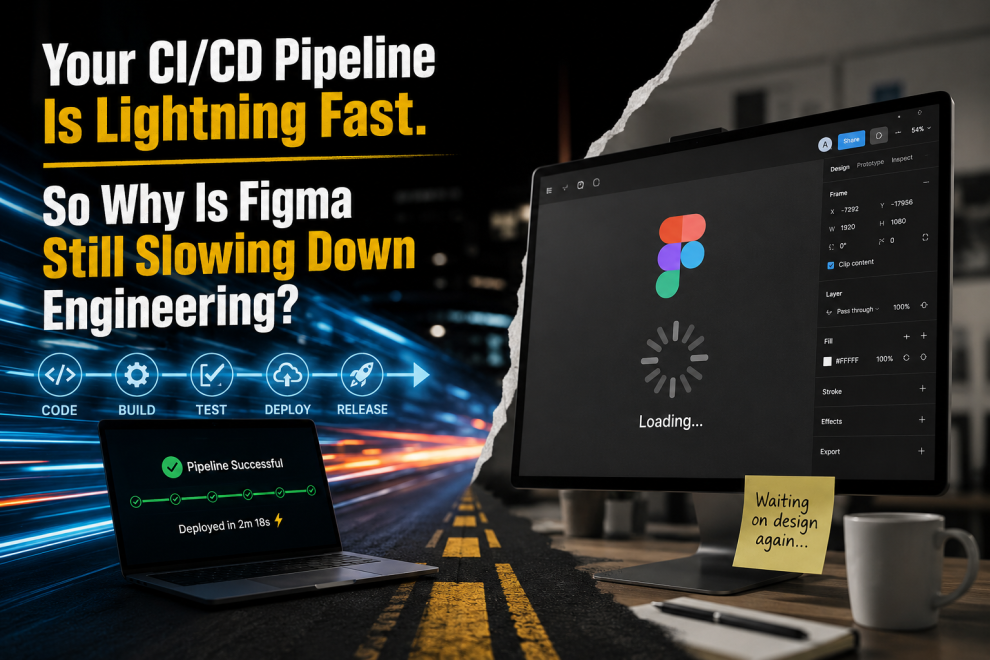

For the last decade, DevOps has been obsessed with one goal: remove friction.
We automated builds. We automated testing. We automated infrastructure provisioning. We automated deployments. Today, it’s possible for a developer to merge a pull request and watch code move from a repository to production in minutes.
That’s an incredible achievement.
Yet many software teams still lose hours every week because of a workflow that hasn’t evolved at the same pace.
Keeping design and production in sync.
It sounds like a design problem, but it’s really an engineering problem.
Every sprint changes the product. New components are introduced. Existing interfaces are refined. Accessibility issues are fixed. Performance improvements alter user interactions. Product teams request experiments that reshape entire screens.
The production application keeps moving forward.
The design file often doesn’t.
Weeks later, designers open Figma to start the next feature only to realize that what they’re looking at no longer matches what’s running in production. Developers explain why certain components changed. Designers recreate existing interfaces. Product managers review mockups that don’t accurately represent the application.
Everyone is doing work that automation should have eliminated.
The Hidden Bottleneck Nobody Talks About
Ask most engineering leaders where delivery slows down, and they’ll mention flaky tests, deployment failures, cloud costs, or infrastructure complexity.
Few mention design synchronization.
That’s because the cost is distributed across multiple teams.
A designer spends an hour recreating components.
A frontend engineer explains implementation differences during review.
A product manager delays approvals because screenshots don’t match the application.
QA reports inconsistencies that already exist in the design files.
None of these tasks seem significant on their own.
Together, they quietly consume dozens of engineering hours every month.
Ironically, organizations that have invested heavily in DevOps often continue relying on one of the most manual workflows in software development.
Automation Shouldn’t Stop at Deployment
DevOps was never just about CI/CD.
The philosophy has always been bigger than deployment automation.
It’s about identifying repetitive manual work and replacing it with reliable systems.
Infrastructure became Infrastructure as Code.
Configuration became declarative.
Monitoring became automated.
Security became integrated into development pipelines.
Why should design remain disconnected from the same philosophy?
If production code already represents the application your users interact with every day, shouldn’t it become the most reliable source of truth?
Instead of rebuilding interfaces manually after every release, engineering teams should ask a different question.
Can design evolve automatically alongside production?
Production Code Knows More Than Design Files
A design file captures intent.
Production code captures reality.
Code knows which components are actually being used.
It reflects responsive behavior, accessibility improvements, animation timing, spacing adjustments, typography updates, and every small refinement introduced during development.
Many of these improvements never make their way back into design tools.
Over time, design systems begin drifting away from the products they’re supposed to represent.
The larger the organization becomes, the more expensive that drift gets.
Multiple product teams begin maintaining different versions of the same component.
Developers hesitate to trust design files.
Designers hesitate to trust production.
Eventually, nobody knows which version is correct.
That’s exactly the type of problem DevOps was created to solve.
A Better Way to Think About Design Systems
Design systems are often described as libraries of reusable UI components.
That’s true.
But they’re also operational systems.
Every inconsistency creates additional maintenance work.
Every duplicate component increases technical debt.
Every manual synchronization introduces opportunities for mistakes.
Treating a design system as part of the engineering platform changes the conversation entirely.
Instead of asking, “Who updates Figma?”
Teams begin asking, “Why does this process require manual updates at all?”
That’s a far more interesting question.
Because it leads directly to automation.
The Rise of Design-to-Code Workflows
The relationship between design and engineering is changing rapidly.
For years, teams focused on moving from design to code.
Now they’re starting to think about the reverse.
What if production components could generate accurate design assets?
What if engineers no longer had to explain why implementation differs from mockups?
What if designers always started with interfaces that reflected the current application instead of last quarter’s release?
Those aren’t hypothetical questions anymore.
Engineering teams are actively exploring workflows that make design and production continuously synchronized rather than periodically aligned.
One example that stood out to me was GeekyAnts’ work on building a bridge from code to Figma. Instead of treating design handoff as a one-way process, the idea is to let production-ready components feed directly into design, reducing duplicate work while keeping both environments aligned.
It’s an engineering-first approach to a problem that has traditionally been treated as a design issue.
Why This Matters for DevOps
Modern DevOps isn’t measured only by deployment frequency.
Engineering organizations increasingly care about lead time, developer productivity, change failure rates, onboarding speed, and cross-functional collaboration.
Design synchronization affects all of them.
When teams spend less time rebuilding existing interfaces, features move faster.
When design accurately reflects production, reviews become shorter.
When engineers and designers share the same source of truth, communication overhead decreases.
These improvements may not appear on infrastructure dashboards, but they have a measurable impact on software delivery.
Automation compounds.
Every repetitive task removed from the workflow creates more capacity for meaningful engineering work.
The Future Isn’t More Tools
The next wave of DevOps probably won’t come from another CI/CD platform.
Most mature engineering organizations already have reliable deployment pipelines.
The bigger opportunity lies elsewhere.
Connecting systems that still operate independently.
Code.
Design.
Documentation.
Testing.
AI-assisted development.
Observability.
Platform engineering.
The organizations that succeed won’t necessarily deploy more often.
They’ll eliminate more friction.
Every manual handoff represents a delay.
Every disconnected system introduces another opportunity for errors.
Every outdated design file creates unnecessary conversations.
That’s why synchronizing production and design feels less like a UX improvement and more like the natural next step in DevOps.
Final Thoughts
DevOps transformed how software reaches production.
The next transformation is about everything that happens before deployment.
Keeping design aligned with reality isn’t simply a convenience for designers. It’s a productivity multiplier for the entire product organization.
When production becomes the source of truth, automation extends beyond servers and pipelines into the way products are designed, reviewed, and evolved.
CI/CD solved deployment.
The next engineering advantage may come from eliminating the workflows that still exist outside the pipeline.





Add Comment