





Enterprise software delivery is entering a new era.
For years, DevOps initiatives focused on automating deployments, improving collaboration between development and operations teams, and accelerating release cycles. Those priorities remain important, but they are no longer enough for enterprises managing large scale digital ecosystems. Today’s engineering organizations operate across multiple cloud providers, distributed applications, Kubernetes environments, AI workloads, and increasingly complex security requirements while maintaining the speed customers expect.
For technology leaders across large enterprises in the United States and Canada, the challenge is rarely finding another DevOps tool. Most organizations already have mature CI/CD pipelines, observability platforms, infrastructure as code, and cloud automation. The real challenge is managing growing operational complexity without continually increasing engineering headcount.
This is why engineering partners are also evolving. Companies such as GeekyAnts are helping enterprises combine AI engineering with DevOps modernization, platform engineering, and cloud infrastructure so organizations can improve software delivery while building on their existing technology investments rather than replacing them.
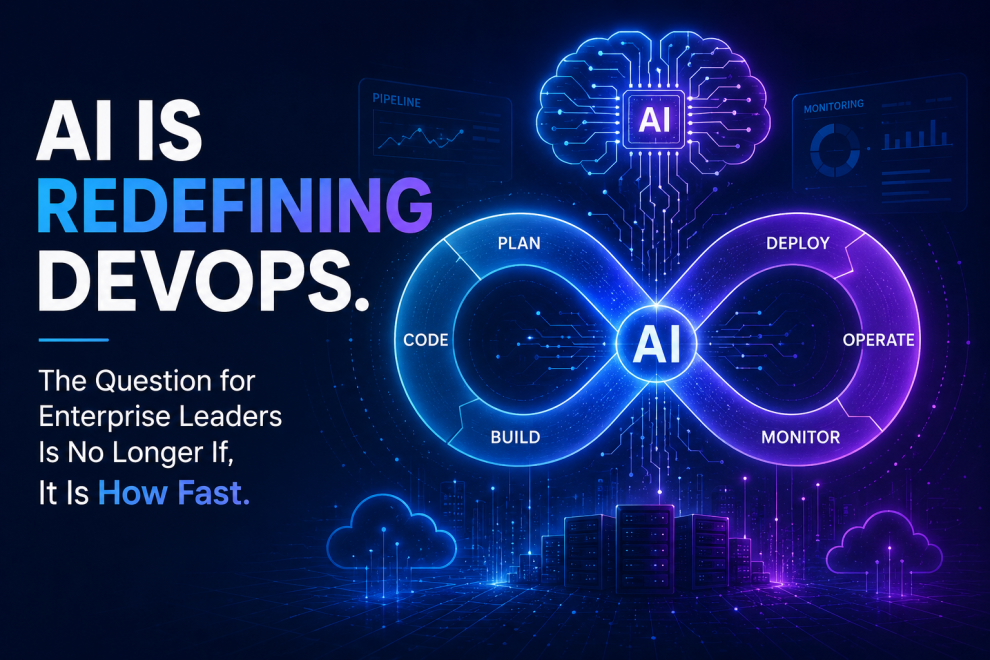
Artificial intelligence is becoming the intelligence layer that helps engineering teams understand, optimize, and automate increasingly complex systems.
According to Google’s 2025 State of DevOps Report, organizations that combine strong engineering practices with platform engineering and AI assisted development continue to achieve better software delivery performance and operational reliability. GitHub also reports growing enterprise adoption of AI powered developer tools as organizations look for measurable improvements in developer productivity.
The conversation has moved well beyond experimentation. Enterprise leaders are now asking how AI can create measurable operational value while maintaining governance, security, and compliance.
Modern DevOps Challenges Are Becoming Business Challenges
Most enterprises already know how to deploy software efficiently.
The bigger challenge is operating software reliably at enterprise scale.
Engineering teams must balance multiple priorities every day. Product teams want faster releases. Security teams expect rapid vulnerability remediation. Finance leaders want cloud spending under control. Customer experience teams measure application performance continuously, while engineering leaders are expected to improve productivity without significantly expanding their teams.
Traditional automation can only go so far.
Automation performs predefined tasks. AI helps engineering teams understand patterns, identify anomalies, prioritize incidents, and recommend actions before small operational issues become major business disruptions.
Several challenges continue to slow enterprise engineering teams.
Alert fatigue remains a major issue because operations teams receive thousands of notifications every day, many of which have little business impact. Root cause analysis often requires engineers to investigate logs, metrics, deployment histories, infrastructure events, and application traces across multiple systems before identifying the real problem.
Infrastructure management presents another challenge. As cloud environments grow over time, unused resources, inefficient scaling policies, and configuration drift become increasingly difficult to identify manually. Platform engineering teams also spend considerable time supporting internal developers instead of improving self service capabilities and engineering platforms.
These operational issues eventually affect business performance. Delayed software releases, longer incident resolution times, increasing cloud costs, and developer burnout all reduce an organization’s ability to innovate and compete.
AI provides an opportunity to reduce these bottlenecks by supporting engineering decision making instead of replacing engineering expertise.
Where AI Is Creating Practical Value Across DevOps
Organizations are seeing the strongest results when AI enhances existing engineering workflows instead of introducing entirely new processes.
Observability is one of the clearest examples.
Modern AI powered observability platforms analyze logs, metrics, traces, and infrastructure events simultaneously. Instead of overwhelming engineers with hundreds of disconnected alerts, AI correlates related events and highlights the most likely cause of an incident. This helps teams resolve production issues faster while reducing unnecessary investigations.
Software delivery pipelines are also becoming more intelligent.
Engineering teams increasingly use AI to review source code, generate automated tests, identify deployment risks, recommend configuration improvements, and assist developers throughout the software development lifecycle. These capabilities reduce repetitive engineering work while helping maintain software quality.
Cloud infrastructure optimization is another area where AI is producing measurable business value.
Enterprise cloud environments often contain underutilized compute resources, inefficient scaling configurations, and unnecessary infrastructure costs. AI systems continuously analyze infrastructure usage patterns and recommend optimizations that improve utilization while lowering operational expenses.
Security operations also benefit from AI assisted analysis. Instead of assigning the same priority to every vulnerability, AI helps engineering and security teams evaluate exploitability, production exposure, and business impact. This enables organizations to focus resources where they reduce risk most effectively.
Developer productivity has also become a major focus.
Internal developer platforms increasingly include AI assistants that help developers troubleshoot deployments, locate documentation, answer infrastructure questions, and resolve common operational issues without waiting for support from platform teams.
Engineering firms such as GeekyAnts are helping enterprises implement these capabilities through AI driven DevOps strategies that integrate with existing cloud platforms, engineering workflows, and enterprise governance models instead of introducing disconnected AI initiatives.
Individually, these improvements may appear incremental. Together, they create engineering organizations that deliver software faster while improving operational resilience and reducing costs.
Successful AI Adoption Requires Strategy, Not More Tools
One misconception continues to slow enterprise AI adoption.
Many organizations believe purchasing AI enabled DevOps products automatically improves engineering performance.
In reality, successful implementation depends far more on strategy than software.
Technology leaders evaluating AI initiatives should focus on three questions.
First, can AI integrate naturally into existing engineering workflows? Enterprise organizations rarely replace CI/CD systems, monitoring platforms, cloud infrastructure, or ticketing solutions. AI should strengthen those investments instead of creating additional operational silos.
Second, does the implementation support governance? AI recommendations that influence production systems require transparency, security controls, auditability, and human oversight, particularly in regulated industries.
Third, will AI simplify engineering operations or create additional complexity? Every new platform introduces training requirements and operational overhead. The objective should always be reducing engineering effort while improving reliability.
Organizations achieving the greatest success typically treat AI as part of a broader platform engineering strategy. Rather than running isolated proof of concepts, they integrate AI across software delivery, infrastructure management, observability, security, and developer experience.
That requires engineering expertise that extends beyond deploying AI models. It requires understanding enterprise architecture, cloud operations, platform engineering, and organizational change.
The Next Competitive Advantage Will Be Built Behind the Scenes
Customers rarely know whether an organization uses AI inside its DevOps operations.
What they notice is a better digital experience.
They notice applications that perform consistently.
They notice fewer production outages.
They notice faster feature releases.
They notice reliable digital services that continue to improve over time.
Those outcomes increasingly depend on how effectively engineering organizations manage complexity behind the scenes.
AI is becoming an essential layer of engineering intelligence rather than another standalone technology initiative. Enterprises that combine mature DevOps practices with AI assisted operations are positioning themselves to scale software delivery without proportionally increasing infrastructure costs or engineering headcount.
For technology executives evaluating the next phase of DevOps modernization, the most valuable conversations are often about architecture, governance, cloud operations, platform engineering, and measurable business outcomes instead of AI alone.
Organizations exploring AI driven DevOps transformation can benefit from consulting experienced engineering partners such as GeekyAnts to evaluate where intelligent automation can create the greatest impact. A strategic assessment often reveals opportunities to improve developer productivity, optimize cloud infrastructure, strengthen platform engineering, and accelerate software delivery without disrupting existing enterprise systems. The first step is not adopting another tool. It is identifying where AI can deliver meaningful operational improvements across the engineering ecosystem.
Read More: On our homepage!


Add Comment